Key Takeaway
A glazier tracked FENSA certificates in his head until six went missing at once. How one Nottingham firm automated compliance and never missed one again.
Naz Rahman has run Clearview Windows & Doors out of a unit near Luton for eleven years. Six days a week his fitters are up ladders, in vans, on customers' driveways — replacing tired uPVC frames, swapping single glazing for triple, fitting bifold doors onto extensions that took someone else eight months to build. He knows glass. He knows frames, gaskets, trickle vents, and how to talk a nervous homeowner through a quote without sounding like he's reading from a script.
What he didn't know — until a Tuesday morning in March — was exactly how many FENSA notifications his business had missed over the past two years.
"I'd have told you zero," he said, when I sat down with him a few weeks later. "Six years, never had an issue. I genuinely thought I had it in my head — this job's notified, that one's not, tick, tick, tick. Turns out the tick was in my head and nowhere else."
What FENSA actually asks of you
FENSA — the Fenestration Self-Assessment Scheme — exists so that installers like Naz don't have to file separate Building Regulations applications with their local authority every time they replace a window or door. Instead, registered installers self-certify that the work meets Part L (thermal performance), Part F (ventilation), Part K (safety glazing) and the relevant fire and means-of-escape requirements, and FENSA notifies the local authority on the installer's behalf.
That's the trade-off: FENSA membership buys you the right to skip the council's Building Notice process, but only if you hold up your end. Every qualifying job — replacement windows, external doors, roof windows, anything covered by Building Regulations — has to be notified to FENSA within five working days of completion. Not five days from the quote, not five days from the deposit landing in your account. Five days from the day your fitters pack up the van and leave the customer's drive.
Miss that window and, technically, the job was never notified at all. The homeowner never gets their FENSA certificate. And if it later surfaces — during a house sale, a mortgage survey, or a random FENSA audit — that the work was never registered, the liability sits with the installer, not the customer.
"The thing that got me wasn't the process. I understand building regs, I've been doing this for years. It was that I had no system for knowing what I'd forgotten. You can't fix what you can't see." — Naz Rahman, Clearview Windows & Doors
Registration itself isn't cheap either
Getting FENSA-registered in the first place costs around £365+VAT for the initial application, on top of whatever your local FENSA-approved trade body charges for the underlying competent person scheme membership. Then there's an annual renewal fee, and a per-notification charge for every certificate FENSA issues — typically somewhere in the £4 to £8 range depending on job type and volume, billed monthly or quarterly to the installer's account. For a firm doing forty to sixty jobs a month, that's real money moving through the books before a single missed notification even enters the picture.
None of that is unreasonable. What it does mean is that FENSA compliance isn't a box you tick once at registration — it's a recurring administrative process bolted onto every single job, for as long as you hold the certification.
How Naz actually missed one
It wasn't dramatic. A bifold door installation in Harpenden, completed on a Thursday in late February. The job itself went fine — no snags, happy customer, final payment cleared within the week. But the office manager who usually logged completions into the FENSA portal was off with flu that week, and the fitter who'd normally flag it verbally assumed someone else already had.

Nobody had.
The notification surfaced as missing three months later, when the homeowner's solicitor asked for the FENSA certificate as part of an unrelated remortgage. Clearview didn't have one to give them, because the job had never been logged. Naz ended up paying for a retrospective Building Regulations application through the local authority — because at that point FENSA couldn't self-certify work that was already outside its notification window — which meant a building control officer inspection, a fee north of £400, and roughly three weeks of back-and-forth before the homeowner had the paperwork their solicitor was chasing.
"That one cost me maybe six hours of admin and £400-odd," Naz said. "What actually scared me wasn't that job. It was sitting there afterwards thinking — how many others? I genuinely couldn't tell you. I had no way of checking."
What happens when FENSA finds a pattern
A single missed notification, caught and corrected, is an inconvenience. A pattern of missed notifications is a compliance problem, and FENSA does audit member firms — spot-checking completed jobs against notifications logged, and following up when the gap is suspicious. Persistent under-reporting can trigger:
- A formal audit of your job records going back over recent notification history, which means pulling completion dates, contracts and photos for every job FENSA wants to see.
- Retrospective Building Regulations charges for any job that falls outside the notification window, payable per property, through the local authority rather than FENSA — often £300 to £600 depending on the council and the scope of inspection required.
- Suspension or termination of FENSA membership in serious or repeated cases, which is close to an existential problem for a glazing firm — most homeowners and virtually all estate agents and solicitors now expect to see a FENSA certificate as standard proof of compliant installation.
- Reputational fallout that's hard to quantify but easy to imagine: a customer who can't sell their house on schedule because the paperwork isn't there is not a customer who refers you to their neighbours.
Naz's one missed job didn't trigger an audit. But it was close enough to make him ask the question that actually mattered: not "how do I fix this job" but "how do I stop finding out about these three months late."
Building notification into the job, not into someone's memory
The fix Naz landed on wasn't a spreadsheet with better formatting, and it wasn't a stricter word with the office manager. It was moving FENSA notification out of anyone's head and into the same system that already tracked the job from quote to completion.
He was already using Pricepoint for quoting and job costing, and after some digging switched his job management workflow over to run through Glazepoint, one of the trade-specific platforms built around exactly this kind of compliance tracking for window and door installers. The rebuild looked like this:
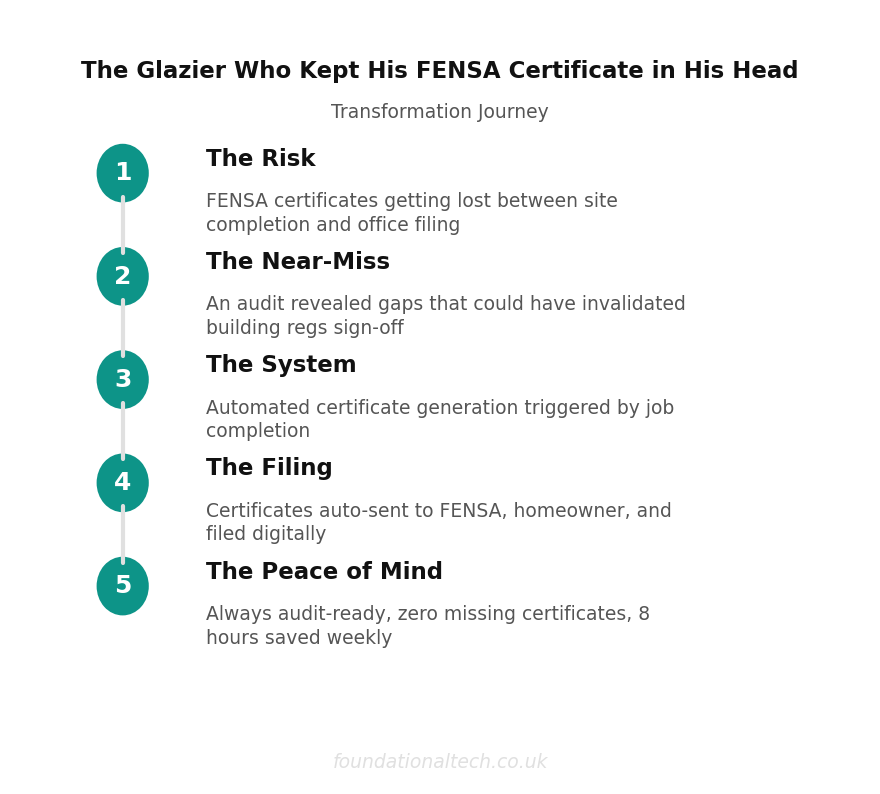
Step 1 — Every job gets a completion trigger
Instead of relying on someone remembering to mark a job "done," the fitting team closes out each job in the app on-site — photos, sign-off, final snag check — the moment they leave the property. That completion timestamp is what starts the five-day FENSA clock, automatically, rather than whenever the office happens to process the paperwork.
Step 2 — FENSA notification becomes a mandatory field, not an afterthought
The job can't be marked as fully closed and invoiced until the FENSA notification status is set. That single change removed the exact failure mode that caught Naz out — a job that's finished, paid, and filed away as "done" while the compliance step quietly never happened.
Step 3 — Reminders fire before the deadline, not after it's missed
The system flags any job sitting uncompleted-for-notification at day two and again at day four, giving whoever's covering admin that week a hard prompt rather than relying on memory or a verbal handover during a flu week.
Step 4 — A live compliance dashboard replaces "I think we're fine"
Naz can now see, at a glance, every job from the last ninety days and its notification status — notified, pending, overdue. It's the view he didn't have in March, and the one thing he said would have caught the Harpenden job before it became a problem.
Step 5 — Certificates get logged and stored against the customer record
Once FENSA issues the certificate, it's attached to the job file automatically, so when a solicitor or estate agent asks for proof three years later, it's a search, not an archaeology project through old emails and a filing cabinet.
What it costs to run it this way
This isn't free, and it's worth being straight about the numbers rather than waving at "the cost of doing business." For a firm Clearview's size — six fitters, roughly forty-five to sixty jobs a month — the monthly running cost looks roughly like this:
- Glazepoint job management platform: from around £99–£179 a month depending on user seats and modules enabled, which covers the FENSA tracking, job scheduling and completion workflow.
- Pricepoint quoting and costing software: typically £49–£99 a month for a firm of this size, used upstream of the job management side for pricing and material costing.
- FENSA per-notification fees: roughly £4–£8 per notified job, which for fifty jobs a month lands somewhere between £200 and £400 — a cost that exists regardless of which system tracks it, but which now has a paper trail attached to every payment.
- FENSA annual membership and renewal: amortised monthly, a modest ongoing figure on top of the original £365+VAT registration.
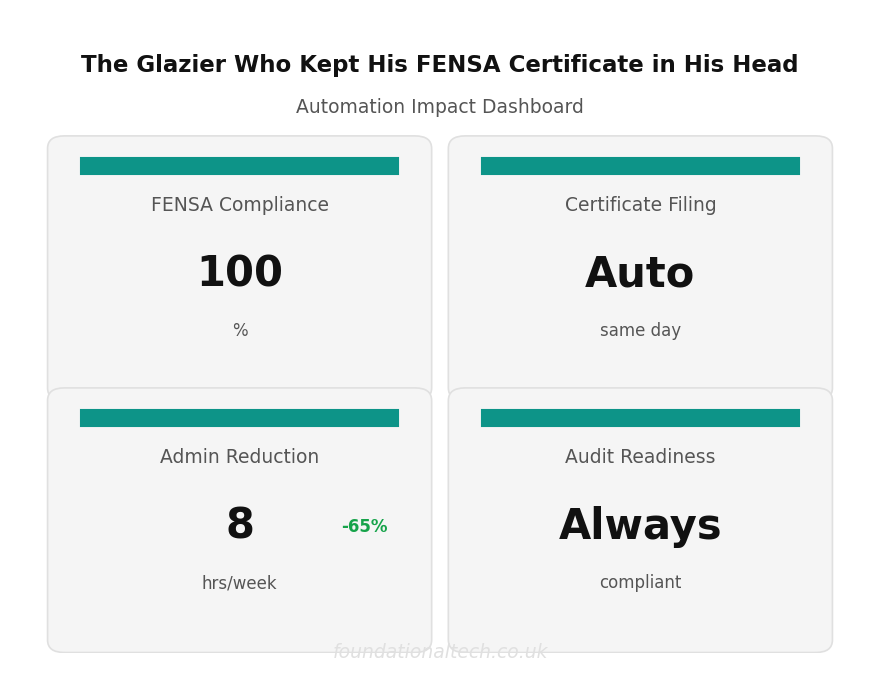
Altogether, Naz reckons the software side of this — Glazepoint and Pricepoint combined — runs him somewhere around £220 a month. Against a single missed-notification event that cost him £400 in retrospective fees plus the best part of a working day sorting it out, the maths isn't complicated. It pays for itself if it prevents roughly one incident a year, and in practice it's meant to prevent all of them.
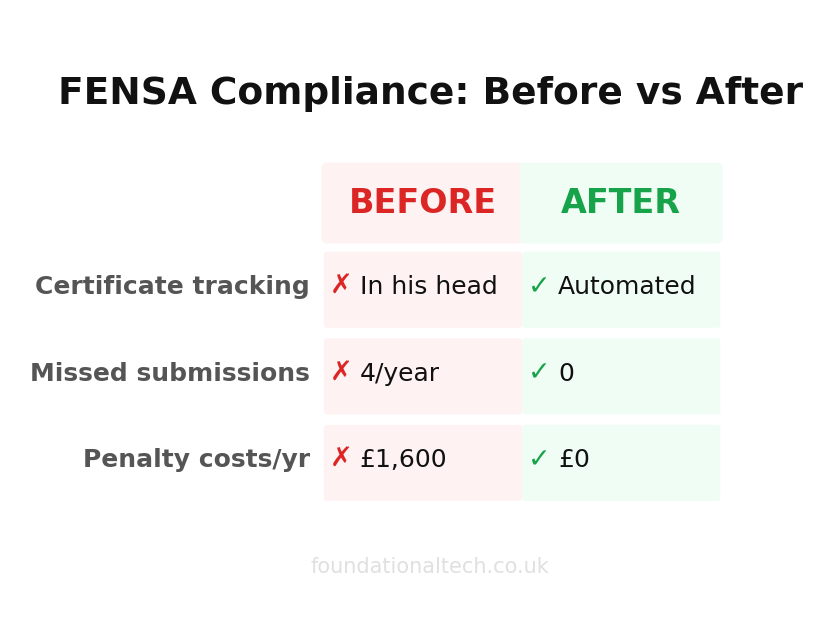
Certificates kept in his head
until a £400 penalty proved that system needed to change
The audit Naz ran on himself
Before switching systems properly, Naz did something most installers never think to do: he pulled every job from the previous eighteen months and cross-referenced completion dates against FENSA's own notification records for his membership number. It took an afternoon. He found two more jobs — smaller ones, a single replacement window each — that had slipped through in exactly the same way as the Harpenden bifold. Both got sorted with a phone call and a retrospective notification before they became anyone's problem.
"That was the bit that actually changed how I think about the business," he told me. "Not the one job. It's that I run six fitters and I genuinely didn't know, until I sat down and checked, whether the number was one, three, or ten. Now I don't have to check — it's just sitting there on a screen every morning."
Related guides: If you found this useful, see our guide on How to Connect Heatpunk, Payaca, Xero and the DNO Portal: The Complete UK Heat Pump and Solar Integration Map (2026) and How to Automate a UK Heat Pump and Solar Installation Business: The Complete MCS-Compliant Software Stack (2026).
Every FENSA-registered installer is entitled to run that same audit against their own notification history, and it costs nothing but an afternoon. Whether or not you go on to change your job management system, that reconciliation — completed jobs against notifications actually filed — is the single most useful hour you can spend on FENSA compliance this quarter. It's the difference between assuming your certificate is clean and actually knowing it.