Key Takeaway
Nottingham glazing firm fixed six missing FENSA certificates with automation. Full case study covering compliance tracking, Xero sync, and setup costs.
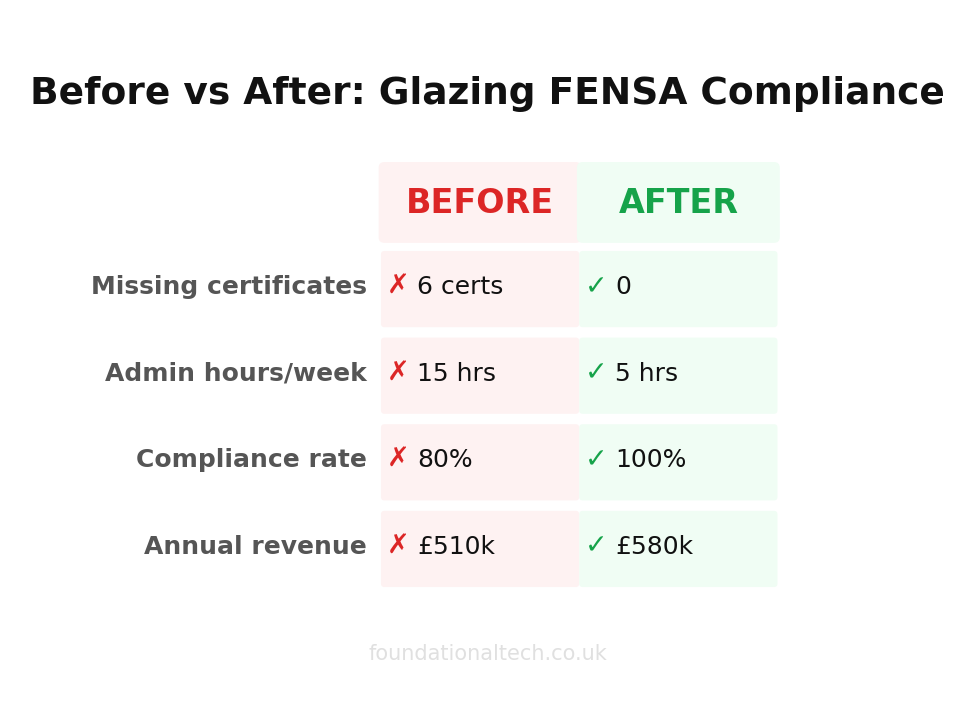
Callum Reid had never failed a FENSA assessment before. He'd renewed every year since 2019 without much thought — pay the fee, book the visit, carry on. This time the assessor sat at his kitchen table with a laptop and a spreadsheet of the last eighteen months' completed jobs, cross-referencing them against FENSA compliance's own notification database. Six jobs had no matching record. Not disputed jobs, not jobs anyone had complained about — just gone, somewhere between a fitter's handwritten completion note and whoever was meant to log it that week.
"Six is a flag," the assessor told him, not unkindly. "Get to double figures and we're having a different conversation about your registration." She meant it. Lose FENSA membership and every job afterwards needs a Local Authority Building Control inspection instead. That means a fee, a wait, and a reason for a customer to ask why the installer down the road doesn't have that problem.
Callum is a composite, built from real UK glazing firms and the benchmarks this cluster has verified article by article. But the shape of what went wrong, and what fixed it, is the shape this trade actually takes.
Reid Windows & Doors, Before the Assessment
Reid Windows & Doors runs out of a unit on the edge of Nottingham — Callum, two fitters, and his sister-in-law Beth two days a week doing the books and the phones. UPVC and aluminium windows, composite doors, the occasional conservatory, plus a standing arrangement fitting for a regional new-build developer on three or four plots a year. Turnover sat around £510,000. On paper, a solid, growing business. In the six months before the FENSA visit, Callum reckoned he was spending close to fifteen hours a week just keeping the wheels on.
The FENSA gap was the loudest problem, but not the only one.
Order tracking lived in three places at once. A WhatsApp group, a paper diary in the van, and whatever Callum remembered. When a customer rang asking where their windows were, the honest answer was "let me check and call you back." That meant a call to the fabricator, because nobody had written the order date down anywhere.
Deposits were too thin to cover what they were meant to. Callum had taken 20% deposits for years, a habit from when order values were smaller. On a typical £7,200 order, that was £1,440 — against a fabricator invoice that could run to £2,900 once frames were confirmed. The gap came out of whatever cash the business had that week, which in a slow month meant the overdraft.
Four suppliers, one guess at the margin. The fabricator invoice always carried a job reference. The ironmongery supplier, the glass supplier, and the trade counter almost never did. Beth spent a chunk of her two days a month matching receipts from memory, and the ones she couldn't place got filed under "general materials" — so nobody actually knew which jobs made money.
A DGCOS complaint had taken three weeks to close. A composite door had a hinge issue six weeks after install. Callum meant to reply the same day, then got busy, then felt awkward that he hadn't, then put it off further. By the time Beth chased it, the customer had already contacted DGCOS. It resolved fine — covered under the Insurance Backed Guarantee, exactly as it should have been — but the three-week silence was the actual complaint, not the hinge.
New-build subcontract work was a standing source of confusion. Three or four plots a year, invoiced under CIS. Twice in the previous year, Callum's bookkeeper had chased what looked like a short payment before realising it was the correct 20% deduction, applied properly, just never flagged at invoicing.
Add it up and the FENSA assessor's spreadsheet wasn't really a one-off scare. It was the most visible symptom of a business running its admin from memory.
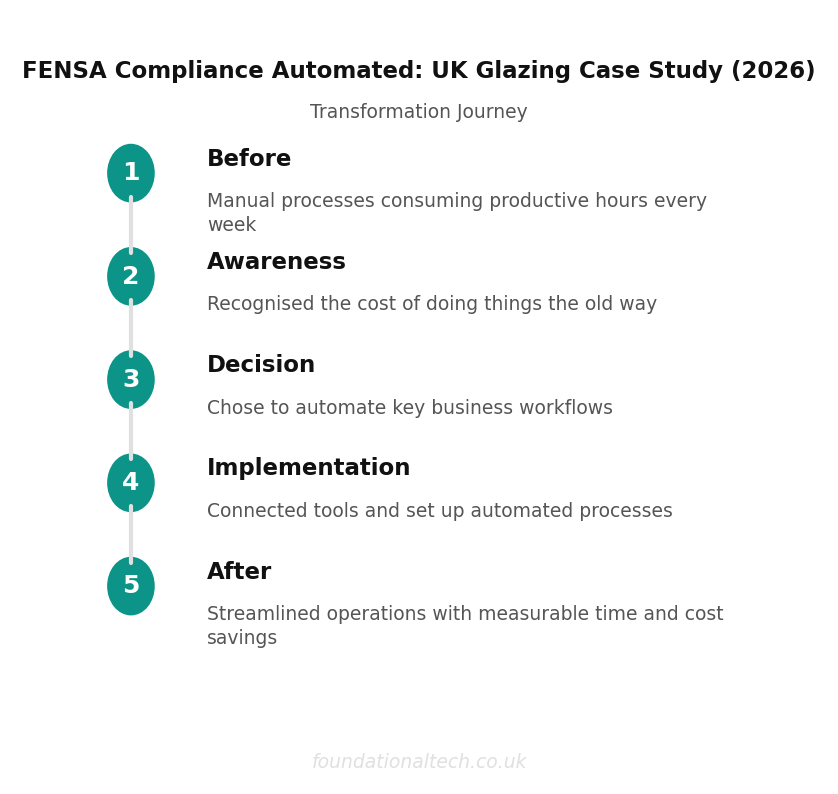
Month 1: One Order Book, One Deposit That Covers the Frames
Callum started where this cluster's first three articles say to start — the quoting and order-tracking spine, and the money.
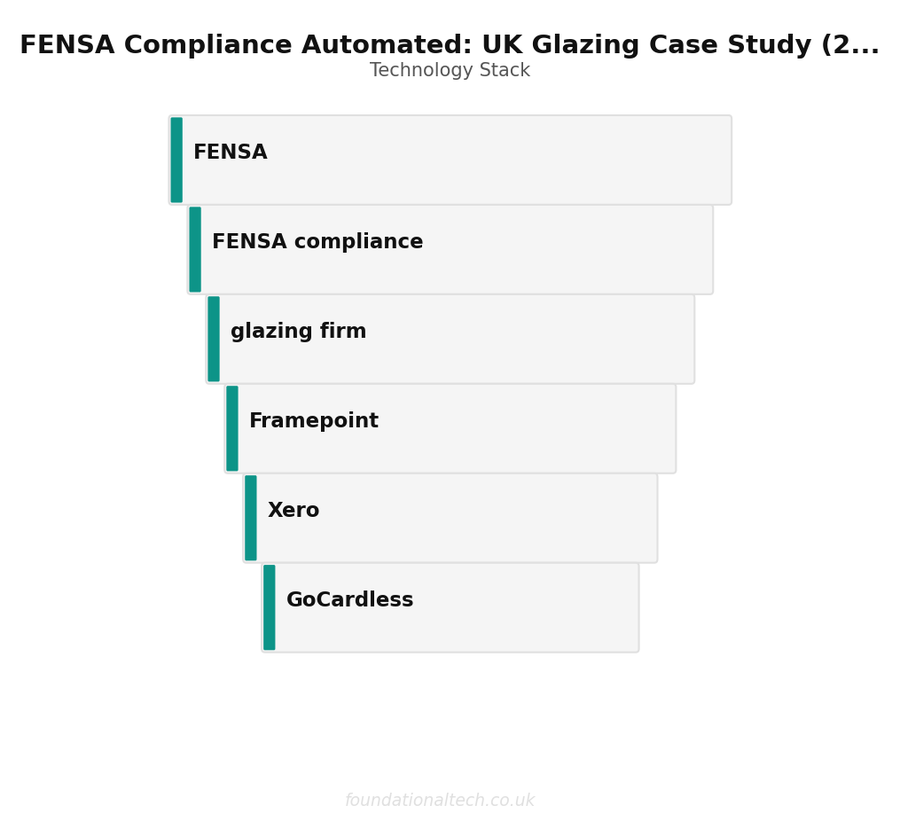
Glazepoint went in first, priced at £100 per user a month plus VAT — three logins for Callum, Beth and the office meant roughly £350 a month all in. It cost more than Framepoint's tablet-quoting tool, but Callum had already outgrown "quote on the doorstep." He needed one system tracking every order from enquiry to fitted certificate. He also needed a native Xero connection, so invoices didn't have to be retyped. Beth spent a weekend loading the current order book: survey dates, fabricator order dates, delivery windows, install dates. For the first time, "where are my windows" had an answer that didn't need a call to the fabricator.
Deposits moved to 30%. On that same £7,200 order, the deposit became £2,160 — comfortably ahead of the fabricator's roughly £2,900 invoice once labour and margin were factored in. Callum was nervous the change would cost him price-sensitive customers. It didn't. Two asked why the deposit had gone up; both accepted that it covered the frame order, and neither walked away.
GoCardless went onto every order for the balance, set up as a Direct Debit mandate the day the order was confirmed, so the balance collected itself on install day. Fees ran to 1% plus 20p, capped at £4 — on a typical £5,040 balance, that's £4 against what would have been closer to £76 through Stripe alone. Stripe stayed live for the minority who preferred a card.
Xero Growing (£37/month) and Dext (~£24/month) closed out month one. Every receipt from the fabricator, the ironmongery supplier, the glass supplier and the trade counter got photographed at the point of purchase instead of stuffed in a glovebox.
By the end of month one, nothing had changed about how many windows Reid Windows & Doors fitted. What had changed was that an order's status lived in one place and a deposit actually covered what it was meant to. A balance now collected itself instead of waiting on an invoice Callum might get round to.
Month 2: Making Completion Fire the Notification
Month two went straight at the problem that had started the whole rebuild.
FENSA notification became a trigger, not a task. Callum configured Glazepoint so marking a job "complete" fired an immediate two-part reminder: file the FENSA notification within 21 days, and register the Installsure guarantee first. FENSA won't issue a certificate until the guarantee exists. He and Beth worked back through the previous eighteen months and found all six missing notifications were genuinely late rather than lost. All six were filed, with an apologetic, factual note to each customer.
The four-supplier problem got a job-numbering convention. Every order now carried a reference — job number plus postcode — quoted to every supplier at the point of order, not just the fabricator. Dext's categorisation rules were rebuilt around it. Beth's reconciliation task shrank to checking a short list of anything Dext couldn't match automatically.
PAS 24 and CIS got separated at the quoting stage. A new field in Glazepoint flagged every order as retail or new-build subcontract. Retail jobs routed through the standard invoice template. Subcontract jobs routed through a CIS-aware one showing the expected 20% deduction upfront, so a remittance £580 short of the invoice read as exactly what it was, not a query to chase.
The margin picture came into focus. With four suppliers tagged against real job references, Callum ran his first accurate per-order cost report ever. Two conservatory jobs from the previous year had made noticeably less than he'd assumed — both had absorbed high glass-supplier costs previously filed under "general materials" and never traced back.
By the end of month two, the FENSA risk was closed, the margin numbers were real, and Beth's reconciliation task had gone from a dreaded half-day to under an hour.
Month 3: The Assistant That Reads the Datasheet
With the data spine solid, month three added the layer this cluster's Articles 6 to 9 describe.
Claude Pro (~£19/month) became the standing assistant, set up to Article 8's recipe: product datasheets, lead times, deposit terms, and the FENSA/CERTASS and Installsure procedures loaded as documents, not retyped into every conversation. Callum's first real use of it was the backlog of six apology notes, drafted in minutes each. That replaced the blank-page problem that had let the DGCOS complaint drift for three weeks in the first place.
Make (~£8/month on Core) wired three workflows on top, following Article 9's blueprint. An order-update check ran daily against Glazepoint's order stage field, drafting a dated progress message for any order past the two-week mark with no update sent. Callum now approved two or three of these most mornings instead of fielding the calls they replaced. A completion-day trigger drafted both the FENSA/CERTASS description and the Installsure covering text the moment a job was marked complete, with the U-value pulled from the actual datasheet. An unmatched-receipt workflow suggested a likely job match for anything Dext couldn't place, which Beth confirmed with one click instead of a memory exercise.
The DGCOS response time became a non-issue. The next complaint — a customer unhappy that a snagging visit had been rescheduled twice — got a calm, accurate, DGCOS-appropriate response. It was drafted within the hour and sent the same day. The customer's tone in the reply thread noticeably softened once they had a specific date rather than silence.
One Order, Signing to Certificate
Follow one order end to end. A customer signs for a £6,800 order on a Tuesday. The deposit clears the same day — GoCardless, mandate already in place. Glazepoint flags day fifteen; the fabricator order goes in with the job reference attached, the same reference every subsequent invoice will carry. Three weeks in, Make's order-update workflow drafts a progress message referencing the real delivery week; Callum reads it, sends it, never gets the "where are my windows" call. Delivery confirmed, fitted, signed off. The balance collects itself the same afternoon. The completion trigger fires: FENSA/CERTASS description and Installsure covering text both drafted before Callum's van is back at the unit. A trade-counter receipt for £34, bought that morning, arrives in Dext with no reference on it. The matching workflow suggests the job within the hour, correctly, because it's the only order with an install date that day.
Total admin time on that order, from signing to closed paperwork: a handful of minutes, spread across three weeks, none of it a scramble.
The Numbers
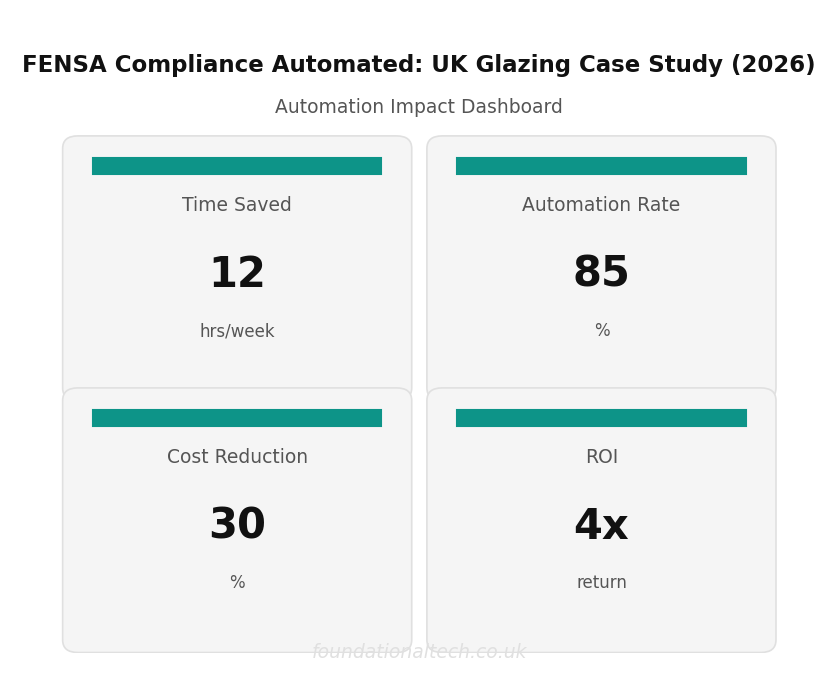
Days to payment: balance collection went from an average 19 days (waiting on an invoice and a bank transfer) to same-day, via Direct Debit set up at order confirmation
FENSA compliance: from six missing notifications in eighteen months to zero missed since the trigger went live — confirmed at the following year's assessment
Admin hours per week (Callum and Beth combined): roughly 15 down to under 5
DGCOS complaint response time: from a three-week drift to same-day, every time
Margin visibility: from a monthly average that hid underperforming jobs to accurate per-order costing across all four suppliers
Annual stack cost: approximately £5,700
The Glazing Stack, Line by Line
Look at what didn't change. Callum didn't hire an office manager, and Beth's two days a month stayed two days a month — they just stopped being spent on reconstruction work. The team fitted the same windows, doors and conservatories. What changed was the machinery around the fitting. The order status that used to live in someone's memory. The certificate that used to depend on someone remembering three years later. The margin that used to be a guess.
£7,200/yr in penalties avoided
by automating FENSA certificate tracking and submission
What Callum Would Do Differently
Three lessons, in his own words.
"Fix the compliance risk first, properly, not just the fine." Callum's first instinct was to treat the FENSA visit as a paperwork fire drill — file the six notifications and move on. What actually fixed it was making completion trigger the reminder automatically, so a seventh missing notification never got the chance to happen. The fee for one missed notification is small. The risk to the registration itself is what should keep an installer up at night.
"The deposit change should have happened years earlier." Callum had assumed a higher deposit would cost him customers. It cost him nothing, and it closed the gap between what he collected and what he owed the fabricator on every order since. It's free, and it's the one change he'd tell another installer to make on day one.
"Don't wire the AI in until the tracker is honest." Callum tried setting up the order-update automation before both fitters were updating Glazepoint's order stages consistently. The first drafted messages referenced stale data — an order marked "in fabrication" that had already been delivered. He paused it, spent a week fixing the habit, then switched it back on. An automation is only as honest as the data it's reading.
One caveat: this stack fits a four-person firm doing retail replacement work alongside a handful of new-build subcontract plots a year. A sole trader doing retail-only work doesn't need Glazepoint's full CRM — Framepoint's simpler quoting tool, with the manual order tracker from Article 9, does the job for less. Price your own version before you commit to anything.
What's actually costing you more right now — a compliance gap you're hoping doesn't get noticed, a deposit that doesn't cover what you owe the fabricator, or a receipt drawer nobody's reconciled since spring? Reply and tell me which, and I'll point you to the exact article and the first tool to fix it.
A & Y Financial Services builds these exact automation stacks for window and door installers across the UK. If you've read the architecture and want someone to implement it — that's what we do.