Key Takeaway
Automate invoice follow-ups for UK bookkeepers and accountants. Set up zero-chase collections with Xero in 2026.
UK SMEs are owed an average of £66,770 in unpaid invoices — a 10% increase year-on-year. Almost two-thirds of invoices sent by small businesses last year were paid late. Collectively, British businesses spent 133 million hours chasing overdue payments in 2025, roughly 86 hours per affected business.
Those are your clients’ numbers. But they are also yours.
If you run a bookkeeping or accounting practice, your own receivables are part of this problem. And worse: you are spending billable hours chasing other people’s invoices too, hours that could be automated out of existence.
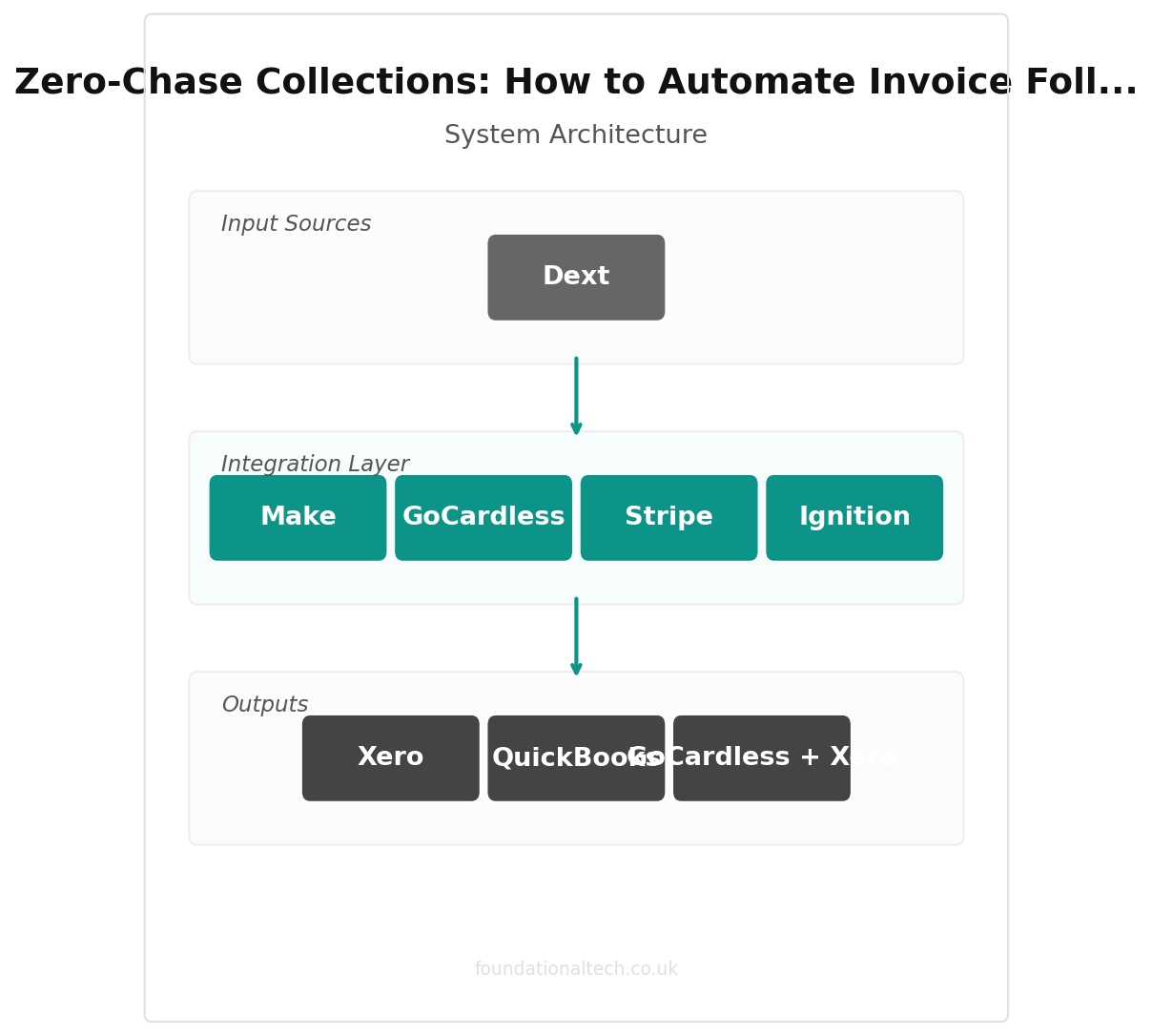
Here is how to build a billing system where nobody chases anything.
The Cash Flow Gap
The root cause is structural, not behavioural. Most firms still operate on an invoice-and-wait model: do the work, send a PDF, hope the client pays within 30 days.
£22,000/yr
average cash tied up in unpaid invoices for UK bookkeeping practices
Around 40% of B2B invoices in the UK are paid late. The average SME loses £22,000 a year waiting on overdue payments. More than a third of business owners have waited up to three months for a single payment.
For bookkeepers billing £500-2,000 per month per client, one late payer can throw off your entire cash flow. Three late payers at once and you are dipping into reserves to cover payroll.
The fix is not better chasing. The fix is removing the need to chase entirely.
The Automated Billing Architecture
Layer 1: Direct Debit Collection via GoCardless
Direct debit is the foundation. Instead of sending invoices and waiting for bank transfers, you collect payment automatically on a fixed date each month. The client authorises this once — ideally at the point of engagement, through Ignition (covered in the previous article in this series) — and every subsequent payment happens without any action from either party.
GoCardless handles the collection. On the scheduled date, it debits the client’s bank account, holds the funds for the clearing period (3-5 business days), and deposits them into yours. The transaction reconciles in Xero automatically.
What happens when a payment fails? The most common failure is insufficient funds. GoCardless’s Success+ feature (available on the Advanced plan) uses machine learning to identify the optimal retry date and time — typically when the client’s account is most likely to have funds. It recovers 70-76% of initially failed payments automatically, without you sending a single email.
UK pricing: Standard plan: 1% + 20p per transaction, capped at £4. No monthly fee. Advanced plan (with Success+ retry): 1.25% + 20p, capped at £5.
The maths: A practice collecting £5,000/month across 10 clients pays approximately £25-40/month in GoCardless fees. That replaces 8-12 hours of monthly invoice chasing.
Layer 2: Xero Invoice Reminders as Safety Net
Not every client will be on direct debit immediately. Some legacy clients resist it. Some project-based engagements work better with ad-hoc invoicing. For these, Xero’s built-in invoice reminder system provides automated chasing without manual effort.
Configure a four-stage reminder sequence:
7 days before due date: “Your invoice for [amount] is due on [date]. If you have already arranged payment, please disregard this message.”
On due date: “Your invoice for [amount] is due today. You can pay by bank transfer to [details] or via the payment link below.”
7 days overdue: “Your invoice for [amount] is now 7 days overdue. Please arrange payment at your earliest convenience. If there is an issue, reply to this email and we will resolve it.”
14 days overdue: “Your invoice for [amount] is now 14 days overdue. If payment is not received within 7 days, we may need to pause work on your account until the balance is cleared.”
Xero sends these automatically. The tone escalates naturally and most clients pay after the first or second reminder — the mere existence of a systematic process changes payment behaviour.
Setup time: 15 minutes in Xero’s invoice settings.
Layer 3: Payment Gateways for Card Payments
Some clients prefer to pay by card. Stripe integrates with Xero and allows clients to pay invoices online via a payment link embedded directly in the Xero invoice email.
UK pricing: 1.5% + 20p per domestic card transaction. Invoicing adds 0.4% per paid invoice (first 25 invoices per month free).
More expensive than direct debit per transaction, but for one-off invoices or clients who refuse a mandate, it removes friction entirely. A “Pay Now” button converts a 30-day wait into same-day payment.
Layer 4: Automated Reconciliation
Every payment — whether collected by GoCardless, paid via Stripe, or sent by bank transfer — flows into Xero’s bank feed. With bank rules configured (covered in article 1 of this series), most payments match to their corresponding invoices automatically.
The reconciliation workflow:
GoCardless payments: Marked as paid in Xero automatically on collection. GoCardless fee recorded as an expense. One-click reconciliation.
Stripe payments: Marked as paid on receipt. Stripe fee recorded separately.
Bank transfers: Xero’s suggested matching algorithm pairs the payment to the correct invoice. For repeat clients, a bank rule handles this without intervention.
A practice with 50 clients should be able to reconcile all payments in under 10 minutes per week.
The Numbers: Before and After
Before automation (typical UK bookkeeping practice, 40 clients):
| Metric | Before | After automation |
|---|---|---|
| Collection time | 30+ days | 3 days |
| Hours on chasing | 86 hrs/yr | ~0 hrs/yr |
| Late payment rate | 40% | Under 5% |
| Revenue at risk | £22,000 | Under £500 |
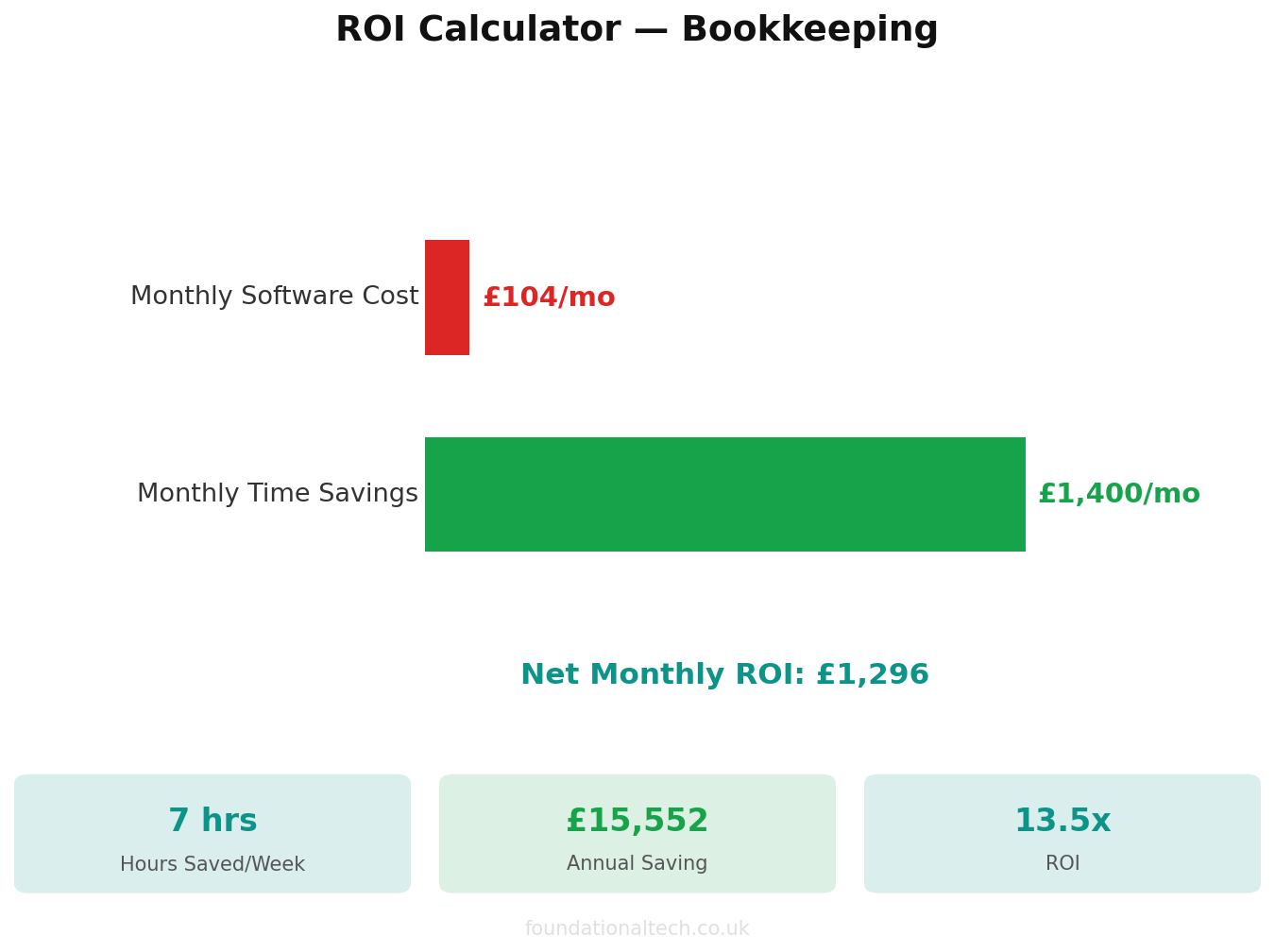
Average days to payment: 34 days. Percentage of invoices paid on time: 55%. Hours per month spent on chasing: 8-12 hours. Cash tied up in receivables at any given time: £8,000-15,000. Annual bad debt write-off: £1,500-3,000.
After automation (same practice, same clients):
Average days to payment: 1 day (direct debit clients), 12 days (invoice clients). Percentage of invoices paid on time: 92%. Hours per month spent on chasing: 0-1 hours. Cash tied up in receivables: £1,000-3,000. Annual bad debt write-off: Under £500.
The cash flow impact is immediate. Moving 30 clients from invoice-and-wait to direct debit puts an extra £10,000-12,000 of working capital back into your practice within the first two months. That is not new revenue — it is money you have already earned, arriving when it should.
The Tools: What to Use and What They Cost
Before we get into the build, let's lay out the toolkit properly — what each tool does, what it costs in the UK right now, and which problem it actually solves. Because the number of options can make this feel more complicated than it is. It isn't. You need at most three of these, and one of them is already built into the software you're using.
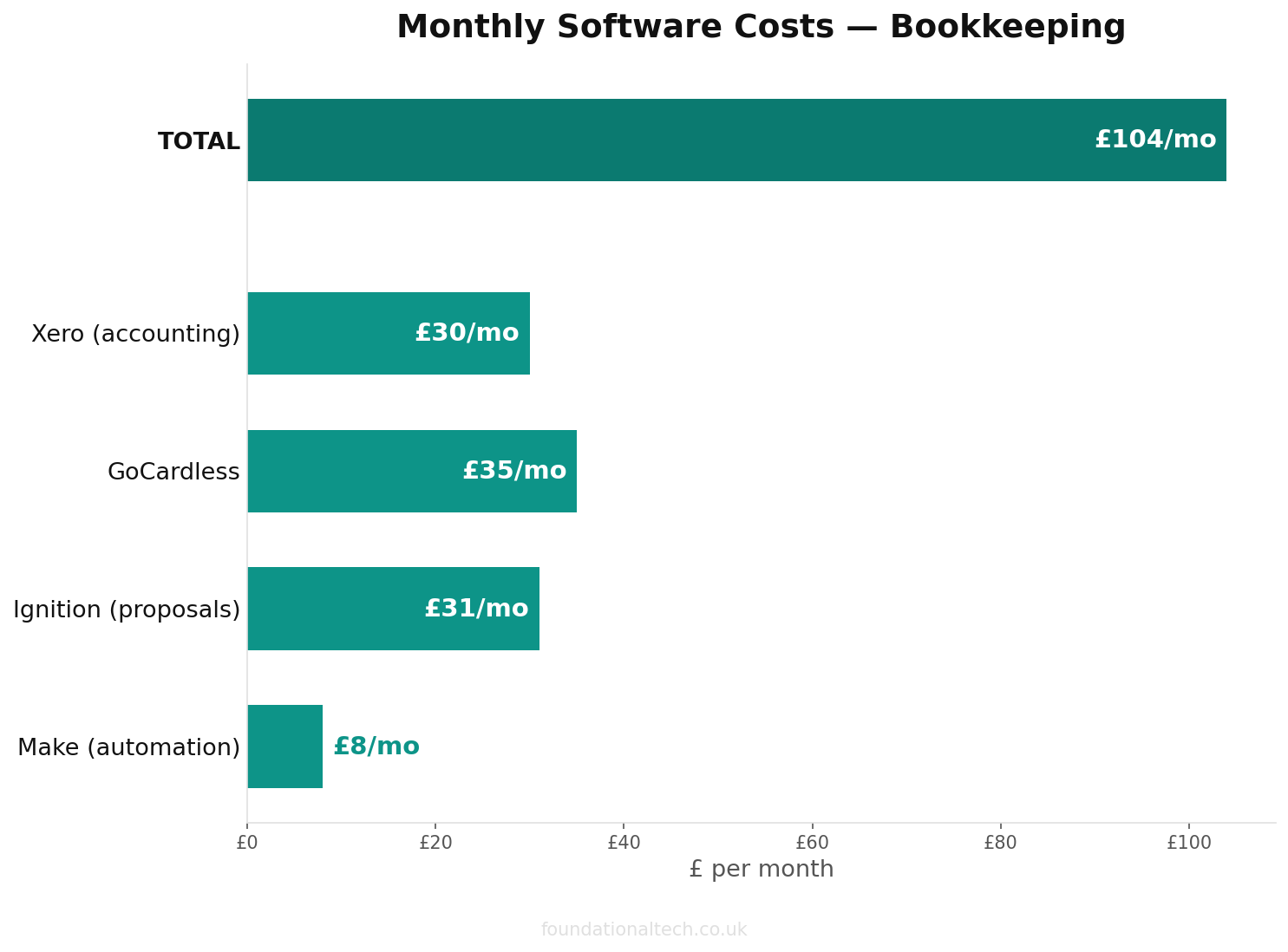
GoCardless (from 2% + 20p per transaction, or fixed plans from £50/month for 50+ mandates) is the backbone of zero-chase billing. You set up a Direct Debit mandate with each client — they authorise it once, online, in about two minutes — and from then on you collect payment automatically on the due date. No invoice. No reminder. No chase. The money leaves their account and arrives in yours on a schedule you control. GoCardless integrates natively with Xero, so the payment reconciles automatically. Best for: recurring fees. Monthly retainers, fixed bookkeeping fees, payroll processing charges — anything that repeats. Setup: enable GoCardless in Xero under Settings > Payment Services, send the mandate request to the client, they click a link and authorise online. The whole process takes less time than writing a chasing email.
Chaser (from £35/month for 100 invoices) is automated credit control bolted onto Xero or QuickBooks. It sends personalised chase emails on a schedule you define — before the due date, on the due date, and at escalating intervals after. It tracks opens and reads, so you know who's seen your email and is ignoring it versus who genuinely missed it. Best for: clients who won't go on Direct Debit, project-based billing, and any situation where you're sending ad-hoc invoices. The key feature that justifies the price: Chaser sends from YOUR email address, not a generic system address. The client sees an email that looks like you wrote it personally. They don't know it was automated. That matters — a chase from "accounts@chasersoftware.com" gets ignored; one from you gets paid.
Xero's built-in invoice reminders cost nothing extra — they're included with any Xero plan. Go to Settings > Invoice Settings > Invoice Reminders and set up three stages: 3 days before due date, on the due date, and 7 days overdue. The templates are basic compared to Chaser — no read tracking, no escalation logic, no analytics — but they catch 60–70% of late payments simply by existing. Most clients who pay late aren't refusing to pay; they've forgotten. A polite automated nudge on the due date is all it takes.
Satago (from £20/month) combines invoice chasing with credit checking in one tool. It integrates with Xero and Sage. The chasing works similarly to Chaser, but the credit check feature is the differentiator — run a quick check on a new client before you take them on and find out whether they have a history of paying late. For practices that have been burned by bad payers, this is insurance. It won't stop every loss, but it flags the obvious risks before you've done the work.
Stripe payment links (1.5% + 20p per transaction) add a "Pay Now" button to every invoice. Xero integrates natively — enable it under Settings > Payment Services > Stripe and every invoice you send will include a link for instant card payment. Even clients who won't set up a Direct Debit mandate will click a payment link. It's the difference between "I'll do a bank transfer when I get round to it" and "I'll pay right now while I'm looking at it." Average payment time drops from 34 days to under 3. Yes, you pay a transaction fee. But 1.5% of an invoice that arrives in three days is worth more than 0% of an invoice you chase for six weeks.
Step-by-Step: Setting Up Zero-Chase Billing in Your Practice
Here's the implementation sequence, in the order that creates the most impact with the least disruption. Don't skip the audit — the numbers will motivate you through the rest.
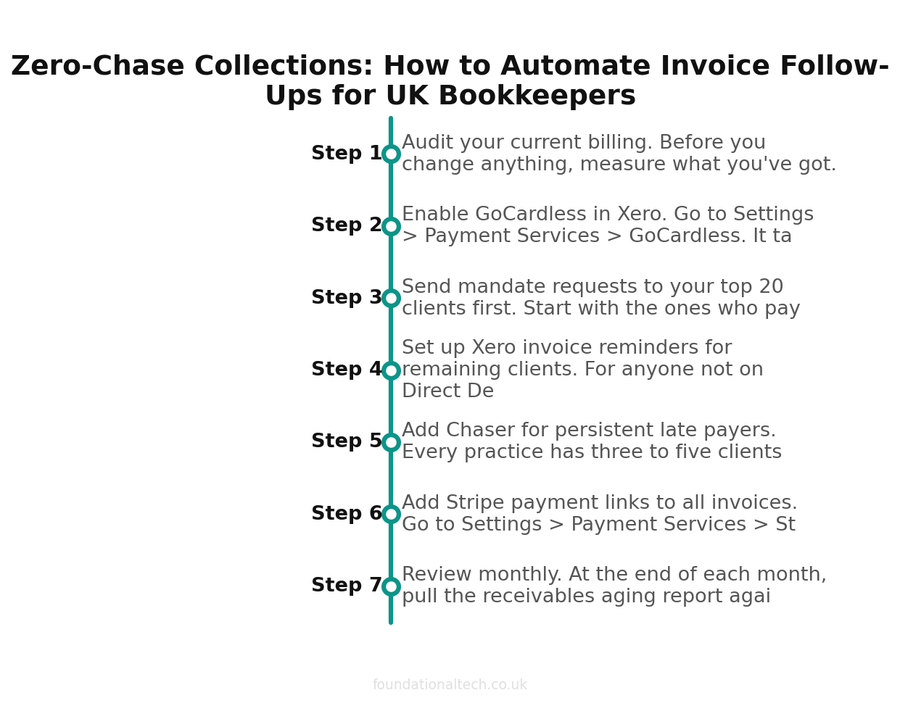
Step 1: Audit your current billing. Before you change anything, measure what you've got. How many clients pay by Direct Debit versus invoice? What's your average days-to-payment? How many hours per month do you or your team spend on chasing? You need the baseline, both because it tells you where to focus and because in three months you'll want to see how far you've come. Pull a receivables aging report from Xero — the numbers usually shock people.
Step 2: Enable GoCardless in Xero. Go to Settings > Payment Services > GoCardless. It takes five minutes. You'll need your practice bank details and a GoCardless account (free to set up). This is the foundation everything else builds on.
Step 3: Send mandate requests to your top 20 clients first. Start with the ones who pay regularly but slowly — the clients who always pay eventually, just never on time. They're the easiest to convert because there's no dispute, only delay. Email template: "We're streamlining our billing to make things easier for both of us. Your monthly fee of £X will now be collected by Direct Debit on the 1st of each month. Please authorise via this link — it takes about 2 minutes." Expect 80% or more to authorise without questions. The ones who push back are usually worried about control — explain they can cancel the mandate anytime through their bank.
Step 4: Set up Xero invoice reminders for remaining clients. For anyone not on Direct Debit, configure the four-stage reminder sequence: 3 days before due date (friendly heads-up), on due date (payment is due today), 7 days after (now overdue), and 14 days after (firmer tone, mention of pausing work). This costs nothing and takes 15 minutes. It handles the majority of late-but-not-problematic payers automatically.
Step 5: Add Chaser for persistent late payers. Every practice has three to five clients who are chronically late despite reminders. For these, Chaser's escalation sequences and read tracking earn their keep. You can see whether the client has opened your invoice email seven times and still not paid — that's a different conversation from someone who never saw it. The automated escalation does what you're too polite to do, in a tone that sounds like you wrote it personally.
Step 6: Add Stripe payment links to all invoices. Go to Settings > Payment Services > Stripe. Now every invoice you send — whether to a Direct Debit client with an ad-hoc charge or to a project client — has a "Pay Now" button. This is the lowest-friction option for clients who want to pay immediately but find bank transfers inconvenient. It also works brilliantly for final invoices on advisory projects.
Step 7: Review monthly. At the end of each month, pull the receivables aging report again. Who's still paying late? Move them to Direct Debit or have the conversation about whether they're worth keeping as a client. A client who consistently pays 60 days late on a £500/month fee is costing you more in cash flow drag than they're worth — and now you have the data to prove it.
Building the System for Your Clients
Here is where this gets interesting for practice owners. Every problem your practice has with cash flow, your clients have ten times worse.
A plumber chasing three overdue invoices loses an afternoon of billable work. A construction firm with £40,000 tied up in 60-day receivables cannot afford materials for the next job. A freelance designer waiting on payment from an agency is dipping into savings to cover rent.
You can build these same systems for your clients as a billable advisory service. The components are identical:
GoCardless + Xero for direct debit collection.
Xero invoice reminders for automated chasing.
Stripe or payment links for instant card payments.
Bank rules for automated reconciliation.
A “cash flow automation setup” for a client takes 2-3 hours of your time. Bill it as a fixed-fee project at £500-1,000. Then charge a monthly advisory retainer to monitor and optimise the system.
Ten of these per year adds £5,000-10,000 in project fees plus ongoing retainer income. It also repositions your practice as a strategic partner rather than a compliance processor.
The One Thing Most Practices Get Wrong
They automate their own billing but leave their clients on manual processes.
Your clients do not know GoCardless exists. They do not know Xero can send automatic reminders. They do not know that a 15-minute configuration change could recover tens of thousands in cash flow.
You do. That knowledge gap is your advisory revenue.
What is your average days-to-payment right now — both for your own practice fees and for your clients’ receivables? The number usually shocks people.
A & Y Financial Services builds automated billing systems for accounting and bookkeeping practices. If you want zero-chase collections configured for your practice and your clients — that is what we do.