Key Takeaway
UK electrician went from 9pm paperwork to paid in 3 days. Full automation case study with Tradify, Xero, GoCardless setup, real costs, and time savings.
When James added up the hours, the number that stopped him wasn't the money. It was twelve. Twelve hours a week, every week, spent on admin he wasn't paid for — quotes at the kitchen table, certificates typed up at night, invoices chased on a Sunday. A full day and a half of his life, gone, on top of a diary that was already full. He was turning over £74,000 a year and he was exhausted by the part of the job no customer ever sees.
This is the story of how he fixed it in three months, what it cost, and what he'd do differently. James is a composite — built from real UK electricians and real industry benchmarks, not one person — but every number here is grounded in what the tools actually do and what they actually cost in 2026.
The Starting Point
James runs a one-van domestic and light-commercial firm out of Leeds, with an apprentice two days a week. Good electrician, fully booked, well-reviewed. On paper, thriving. In practice, drowning.
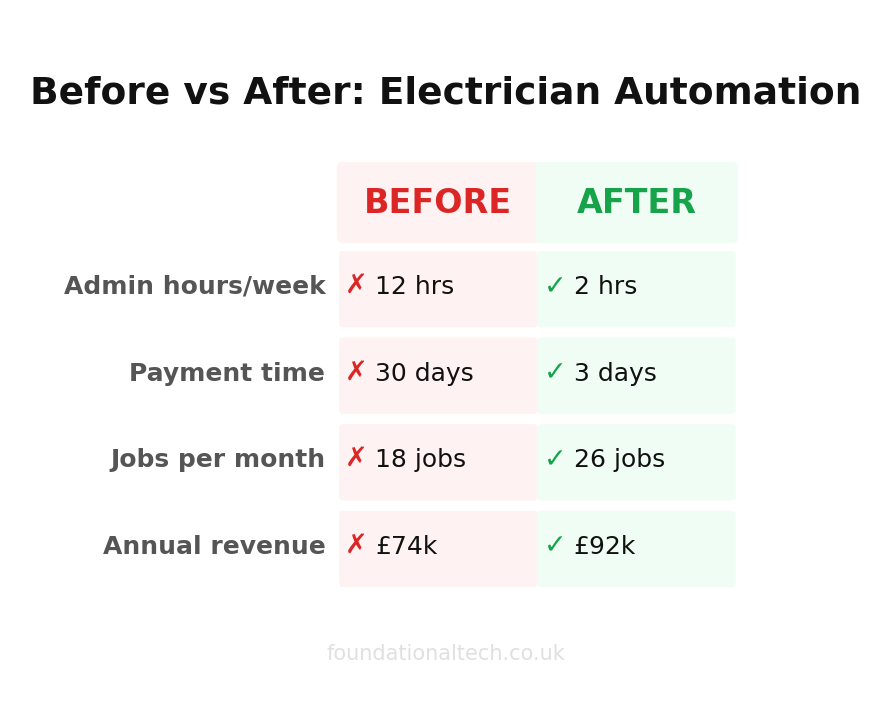
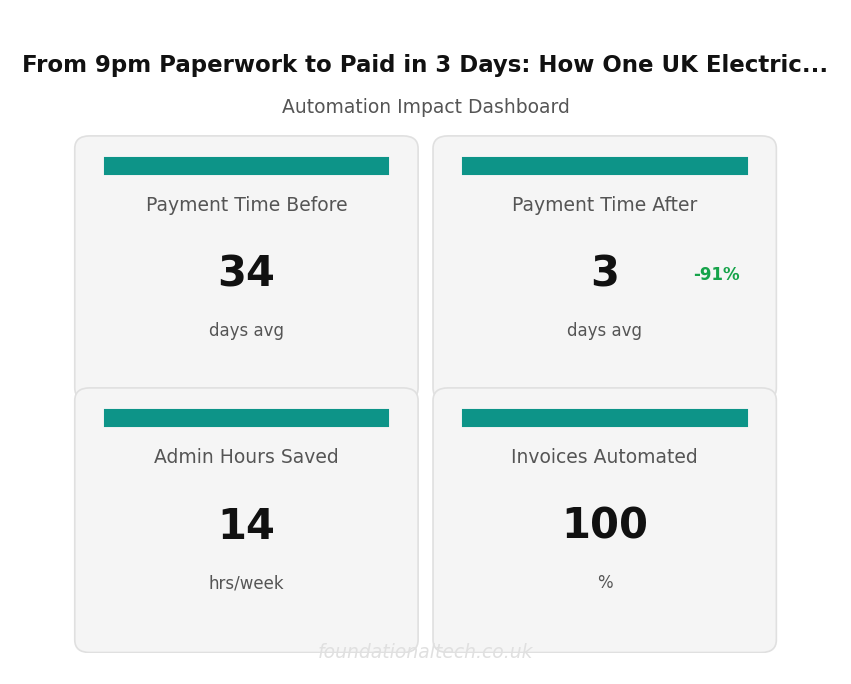
His week looked like this. Quotes were written by hand in the evening, often days after the survey, by which point a faster electrician had sometimes already won the job. Certificates — EICRs, EICs, Minor Works — were typed up at night from scribbled notes. Invoices went out late, in a batch, whenever he got round to it, and then sat unpaid. His average time from finishing a job to seeing the money was thirty-four days, and at any given moment he was owed somewhere north of £6,000. Receipts lived in the van door and the footwell, and most of January was spent reconstructing a year of them for his accountant.
The diary was full but the bank account was tight, because the work was done and the money hadn't caught up. He wasn't short of jobs. He was short of a system.
The clearest sign of the problem was a job he lost without ever knowing why. A landlord with a block of four flats emailed on a Tuesday morning asking for EICRs on all of them — a £1,600 booking, the kind of repeat client that keeps a one-van firm steady. James saw the email during his lunch break, meant to reply that evening, and forgot. He remembered on Thursday and sent a careful quote. The landlord had already booked someone who'd answered within the hour. That one missed reply was worth more than three months of software, and it wasn't the first.
Month 1: The Foundation
James didn't start with anything clever. He started with the production engine.
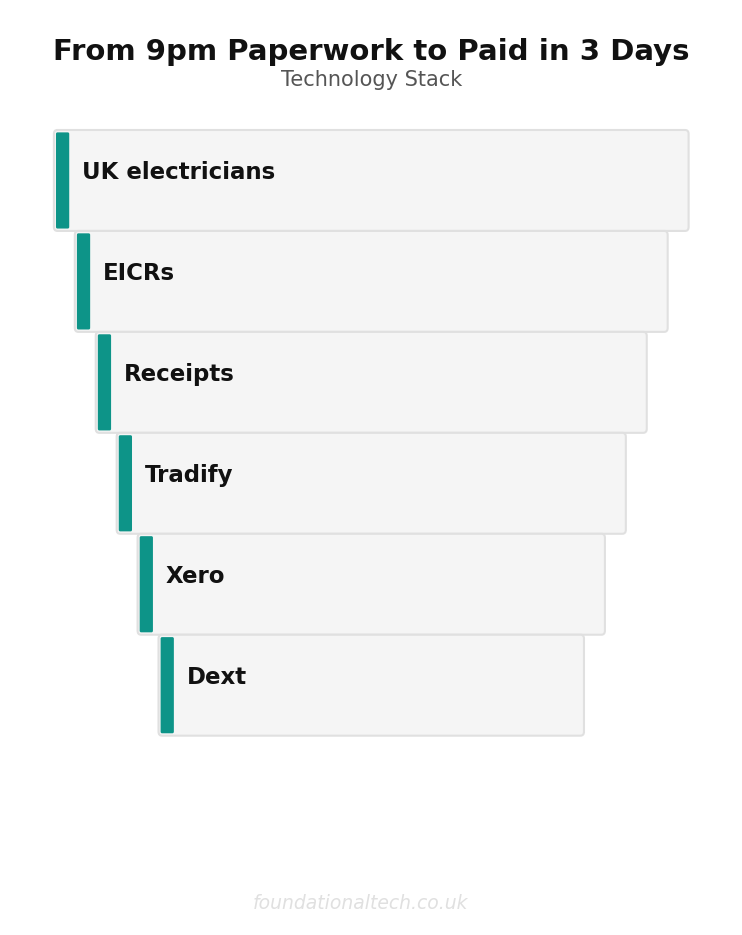
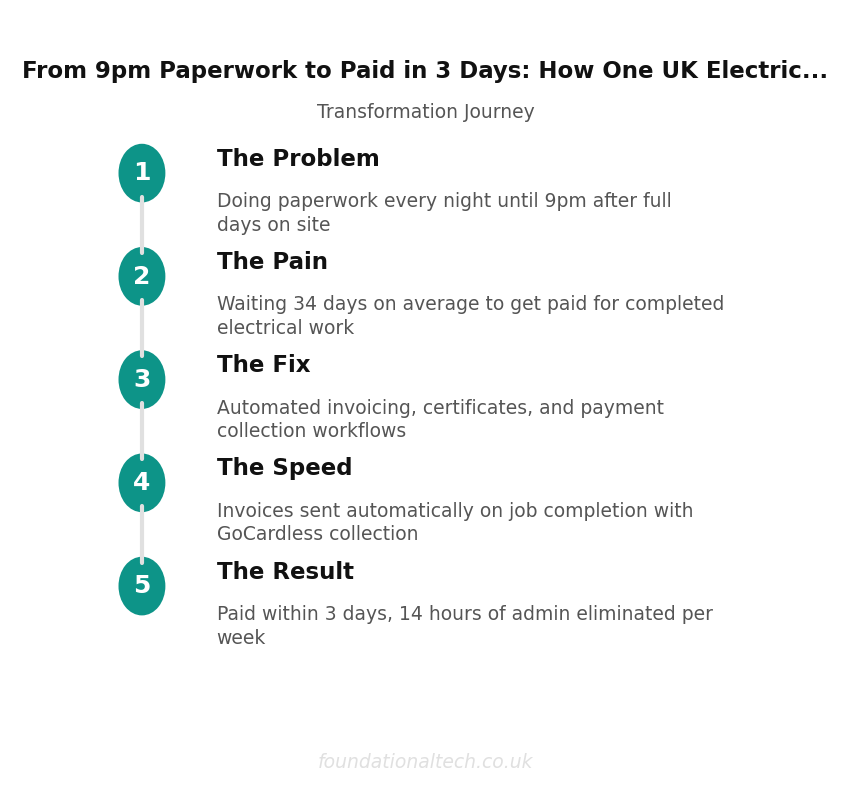
He moved his quoting and job management into Tradify (£34 per user per month on the Lite plan), so quotes could be built and sent from his phone on site instead of from the kitchen table at night. He connected it to Xero (Ignite, around £15 a month plus VAT), so every invoice he raised flowed straight into his accounts and his bank feed matched the payment when it landed. Reconciliation stopped being an evening with a highlighter and became a thirty-second tap on the sofa.
Then he plugged the cash leak. Dext (from £24 a month) turned the shoebox into a photo: snap the wholesaler receipt at the counter, and the supplier, VAT and total land in Xero tagged and ready. The footwell emptied out.
The single biggest change came last and cost the least. He put his maintenance and landlord clients onto GoCardless Direct Debit, which charges 1% plus 20p per transaction, capped at £4, with no monthly fee. A £1,400 invoice now cost him £4 to collect and collected itself on the due date — no phone call, no waiting, no chasing.
There was one more change that paid for itself within a fortnight. James had been typing his EICRs and Minor Works certificates from scribbled site notes at night, then emailing PDFs days later — sometimes a week after the job, by which point the landlord had chased him for it twice. He moved to Tradify's Plus plan (£44 per user per month), which carries the certificate templates, and started completing them on his phone before he left site. The certificate now landed in the customer's inbox while James was still loading the van, and the "where's my certificate?" emails stopped entirely. For a firm doing landlord and rental work, that alone changed how clients saw him: he went from the electrician who was always a bit behind on paperwork to the one who had it done before he'd driven away.
By the end of month one, nothing about James's electrical work had changed. The plumbing of his business had. Quotes went out same-day. Invoices raised themselves on completion. And the money started arriving on a schedule instead of whenever a customer remembered.
Month 2: The AI Layer
With the foundation solid, James added the assistant on top.
He took out a Claude Pro subscription (around £18 a month) and spent one evening setting it up properly — pasting in his standard scope of works, his tone, his prices as a guide. After that, writing a quote changed shape. He'd finish a survey and dictate his rough notes into his phone — "consumer unit swap, 1930s semi, no RCBOs, customer nervous about cost". Then he'd ask the AI to turn them into a warm, plain-English quote that explained why the work mattered for safety and left the price as a placeholder. The forty-minute job became a five-minute one, and the writing was friendlier than anything he'd have managed at half past nine.
He used the same assistant for the awkward stuff: the firm-but-polite payment chase, the reply to a letting agent's rambling email listing eight EICRs, the follow-up two weeks after a job asking for a review. None of it replaced his judgement. All of it removed the blank-page paralysis that had been the real reason admin piled up.
The difference was easiest to see on a single quote. Before, a consumer-unit upgrade for a nervous homeowner meant forty minutes at the kitchen table, trying to explain gently why the old fuse board wasn't safe and why the cost was fair. Half the time he gave up and sent three blunt lines that won nothing. After, he dictated the facts, asked the assistant to explain the safety reasoning in plain English and keep the tone warm, and read back a quote that did the selling for him. His quote-to-win rate on those nervous domestic jobs went up, not because his prices changed, but because the customer finally understood what they were paying for. The writing had been costing him work, and he hadn't realised it.
This is the bridge the AI automation articles in this series were building toward — not robots, just the unbillable evening writing done in a fraction of the time.
Month 3: The Compound Effect
In month three, James wired the two halves together, exactly as Workflow 1 in the previous article describes. An automation in Make (free tier, then the £7-a-month Core plan once he leaned on it) watched his enquiry inbox, fed each new message to the AI, and dropped a drafted reply into his drafts folder. A new enquiry now got a same-minute, on-brand response while James was still up a ladder. He went from replying that evening — if at all — to replying within minutes, and the jobs he'd been quietly losing to silence started landing.
A second automation watched Tradify for completed jobs and queued an AI-drafted review request a day later. His Google reviews, which had crept up by ones, started arriving every week — and reviews, in a trade where everyone checks them first, quietly feed the next month's enquiries.
The change showed up in a single morning that stood out to him. A homeowner messaged at 7:40 am asking about an EV charger install while James was driving to his first job. By the time he parked, a drafted reply was waiting in his phone — area confirmed, an honest price range, a note that it depended on a survey for the cable run, and two slots offered that week. He read it, changed one line, and sent it before he'd lifted his toolbag. He'd have a survey booked by lunch. Six months earlier that enquiry would have sat unread until nine that night, by which point the customer had moved on.
Everything was now talking to everything. The enquiry became a quote in Tradify, the quote became a job, the invoice raised itself into Xero, GoCardless collected it, Dext swept up the receipts, and the VAT return assembled itself for one-tap submission to HMRC. James's only jobs in the chain were the ones that needed him: doing the work, checking the numbers, pressing send.
The Numbers
Hours saved per week: 9 (from roughly 12 hours of admin down to about 3)
Revenue increase: around 18% over the quarter, driven mainly by enquiries that no longer went cold
Days to payment (before → after): 34 days → 3 days on Direct Debit clients
Client capacity increase: roughly 8 extra jobs a month, won back from faster replies, with no extra hours on the tools
Annual cost of the full stack: about £1,400 a year (see below)
ROI: 9 recovered hours a week at £40 an hour is roughly £1,500 a month of time; the stack costs about £115 a month. The time saving alone returns more than ten times its cost, before a penny of extra revenue
The Full Stack Summary
Total: roughly £100–£115 a month for a sole trader, depending on receipt volume and how hard the automations work.
The Part That Nearly Didn't Stick
It almost went wrong in month two. Excited, James tried to build five automations in a single weekend — inbox replies, review requests, certificate reminders, a quote-chaser, a job-folder creator. Within a fortnight two had broken silently, and he didn't notice until a customer complained they'd never heard back. He nearly binned the lot.
What saved it was slowing down. He stripped it back to one workflow, lived with it for a week until he trusted it, then added the next. He also switched on the failure alerts in Make, so a broken automation emailed him instead of failing in the dark. The version that stuck wasn't the ambitious one. It was the patient one.
Is This Realistic for Your Business?
Because James is a composite, the fair question is which results travel. The cash-flow gains are the most repeatable. Raising invoices on completion and collecting repeat work by Direct Debit pulls payment forward for almost any electrical firm. The problem it fixes — invoices sent late and never chased — is close to universal in the trade. If you do nothing else, those two changes are worth more than the whole stack costs.
The revenue jump is more variable. James won extra work mainly because demand existed and he'd been too slow to catch it. A firm already replying within the hour will see a smaller lift — the instant-reply workflow can only recover work that's currently leaking away. So look at your own numbers: how many enquiries do you fail to answer in time each week? The size of that leak is the size of your likely gain.
The time savings are the most reliable of all. If you're writing quotes at the kitchen table and typing certificates on a Sunday, wiring the stack together hands those evenings back regardless of how busy the diary is.
£18,000/yr extra revenue
from 8 extra jobs per month after automating quoting and invoicing
What They'd Do Differently
Three lessons James would pass on.
First, fix the foundation before the AI. He was tempted to start with the exciting bit, but the real money came from same-day quotes and automatic payment collection. AI made a good stack faster; it could never have rescued a broken one.
Second, automate payment collection earliest. GoCardless moved the needle on cash flow more than anything else, and it was the fastest win. If he'd done only one thing, it would have been that.
Third, build one workflow at a time and keep a human pressing send on anything that touches a customer, a price, or a certificate. The goal is to free your hands, not hand over the wheel.
The honest part of the story is that none of it was clever. There was no secret tool, no expensive consultant, no software an electrician can't set up himself across a few evenings. What changed James's business was sequence — foundation first, AI second, one workflow at a time — and the discipline to let the machine do the carrying while he kept every decision. He isn't bigger and he isn't working harder. He's simply stopped being the bottleneck in his own company.
Could your electrical business achieve similar results? Reply with your single biggest bottleneck — late quotes, slow payments, or missed enquiries — and I'll tell you which part of this stack to build first.
Related guides: If you found this useful, see our guide on AI Automation for Electricians: 3 No-Code Workflows That Connect ChatGPT to Tradify, Xero and Your Inbox (UK 2026) and How to Connect Tradify, Xero, GoCardless, Stripe and Dext: The Complete Electrical Integration Map (2026).
A & Y Financial Services builds these exact automation stacks for electrical businesses across the UK. If you've read the architecture and want someone to implement it — that's what we do.