Key Takeaway
Automate compliance and de-risk your UK law firm. SRA obligations, conflict checks, file reviews, and real-time monitoring built into one architecture.
The Liability of Human Middleware
I spent the better part of last Tuesday sitting across from a managing partner in Manchester who had just received a Section 44 notice from the SRA. His firm — fourteen solicitors, three offices, a respectable conveyancing and commercial litigation practice — had commingled client funds with office money on two separate occasions in the preceding eighteen months. Neither incident was intentional. Both were the result of a cashier manually reconciling trust accounts in a spreadsheet she had inherited from her predecessor in 2019.
£15,000/yr
average cost of a single compliance failure for a UK law firm
The fine was £15,000. The reputational damage, incalculable. And the root cause was not incompetence or negligence in any morally meaningful sense. It was the entirely predictable consequence of asking human beings to perform repetitive, rule-bound tasks without error, hundreds of times per month, indefinitely.
This is what I call the human middleware problem, and it sits at the centre of nearly every compliance failure I investigate. Somewhere between the regulation and the outcome, a person is acting as a manual relay — checking a box, moving a number, remembering a date — and sooner or later, that relay fails.
In my work with UK law firms, I see three failure points that account for the vast majority of regulatory risk:
- Financial mishandling: Breaches of the SRA Accounts Rules 2019, particularly around client money segregation, residual balances, and reconciliation timing.
- Deadline failures: Missed limitation periods under the Limitation Act 1980, late court filings, overlooked CPR deadlines — each one a potential negligence claim.
- Data exposure: GDPR Article 5 violations, inadequate subject access request processes, and failures to maintain ethical walls in conflict-sensitive matters.
Each of these failure points is structurally identical. A rule exists. Compliance with that rule requires consistent, repeatable action. A human being is performing that action manually. And the question is not whether that human will eventually make a mistake, but when.
The answer, increasingly, is to remove the human from the middleware layer entirely — not to eliminate jobs, but to eliminate the category of error that no amount of training or diligence can fully prevent.
The De-Risked Tech Stack
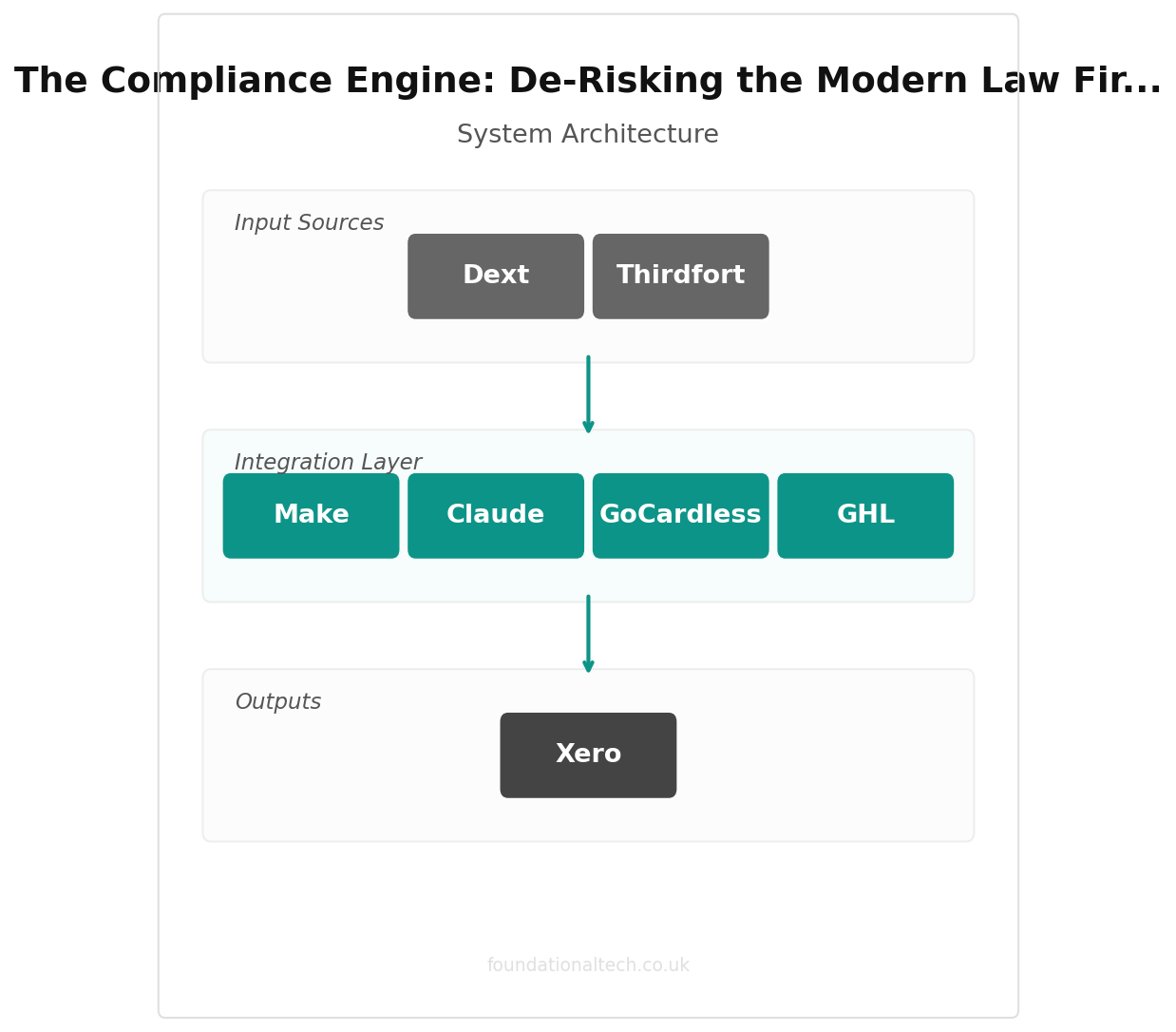
What follows is not a theoretical framework. It is the specific set of tools, integrations, and workflows I deploy with firms ranging from five to fifty fee earners. Every product mentioned is available in the UK, priced in sterling, and tested against the regulatory environment that actually governs English and Welsh solicitors.
1. Financial Compliance: SRA Accounts Rules and Client Money Protection
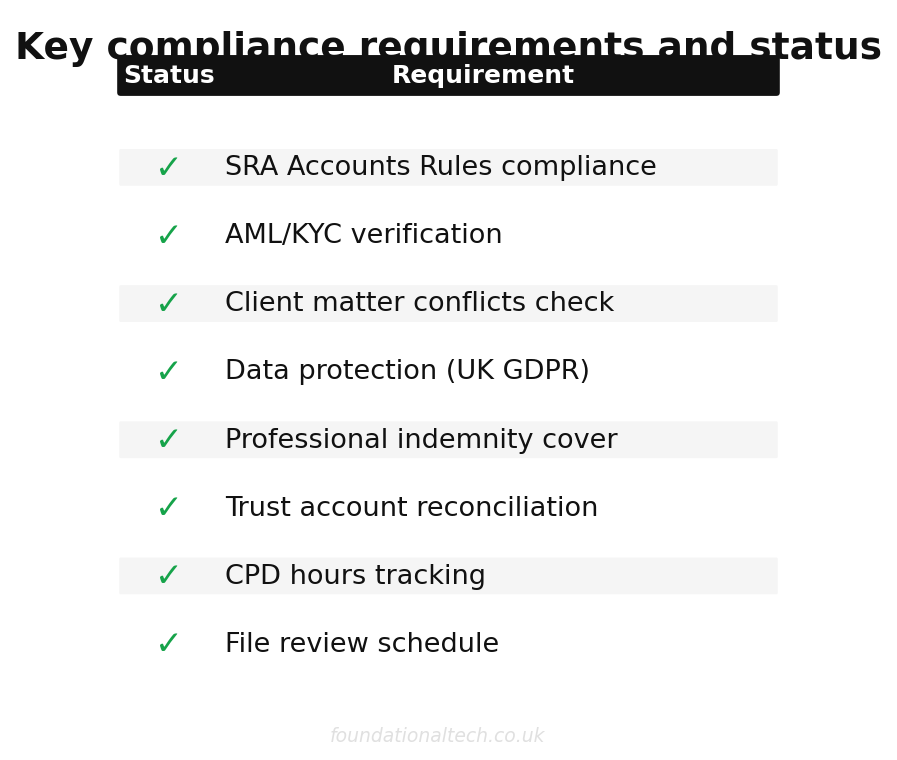
The SRA Accounts Rules 2019 are deceptively simple in principle — keep client money separate from your own — and brutally unforgiving in practice. Rule 2.1 requires that client money is kept in a client account, separate from the firm's own money. Rule 3.3 mandates that firms must correct any breaches of the rules promptly. Rule 8.3 requires reconciliation of client accounts at least every five weeks.
Where firms get into trouble is not usually at the policy level. They know the rules. The problem is in the daily mechanics: a payment lands in the wrong account because someone transposed two digits. A residual balance sits in a client ledger for seven months because no one flagged it. A third-party payment goes out before the corresponding client funds have cleared, creating a momentary but real shortfall.
The firm I mentioned in Manchester had both incidents triggered by the same structural flaw: their practice management system was not connected to their banking platform, so every transaction required manual entry into two separate systems. Duplication meant divergence, and divergence meant breach.
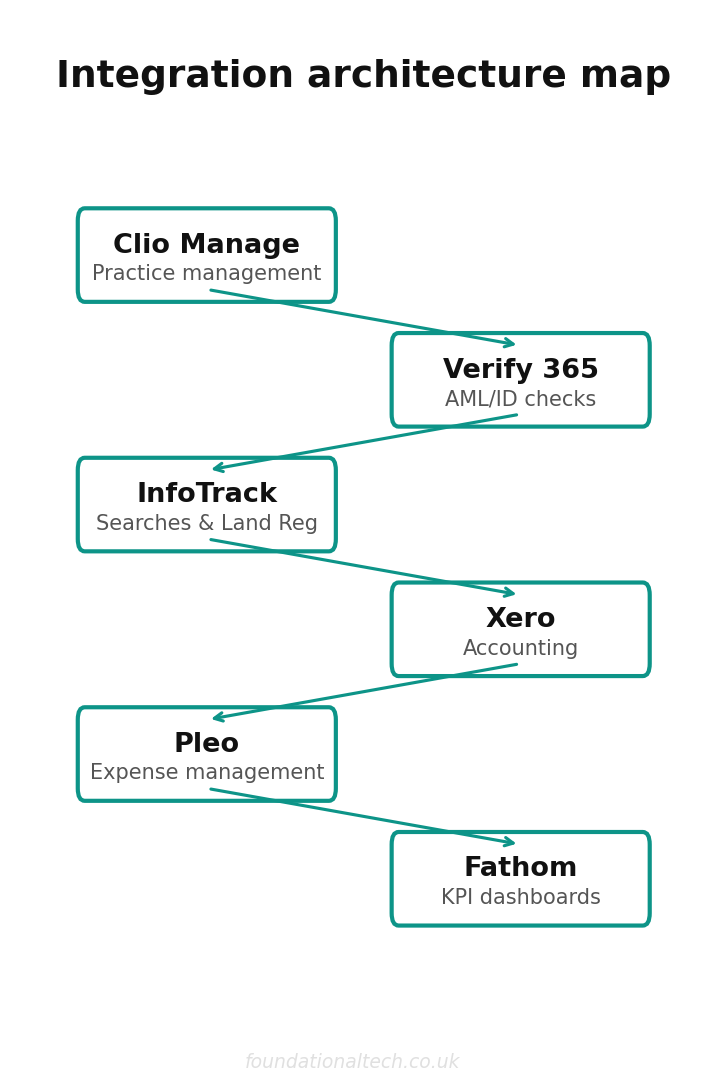
The fix involves two components working together. First, a practice management platform with integrated accounting that enforces segregation rules at the system level. Clio Manage (from £59/user/month) provides this, with client and office account ledgers that prevent posting errors through validation rules — you physically cannot post a receipt to the wrong account type without overriding a warning. Osprey Approach (from £55/user/month) offers similar protections and is purpose-built for the UK regulatory environment, with SRA-compliant trust accounting baked into its ledger structure.
Second, payment processing that routes funds correctly before they ever reach your bank account. GoCardless handles this elegantly — it charges 1% + 20p per transaction, capped at £4 per payment. The critical feature is not the fee structure but the routing logic: payments can be configured to land directly into the appropriate client or office account based on matter type, eliminating the manual allocation step entirely.
The workflow I deploy looks like this:
- Client receives an invoice generated from Clio Manage with an embedded GoCardless payment link.
- Payment is initiated by the client via Direct Debit or open banking.
- GoCardless routes the funds to the designated client or office account based on the matter configuration in Clio.
- Clio automatically reconciles the payment against the corresponding ledger entry.
- The five-weekly reconciliation required by Rule 8.3 runs automatically, generating an exception report rather than requiring manual line-by-line review.
The Manchester firm implemented this workflow in March. They have not had a reconciliation discrepancy since.
2. Deadline Risk: Limitation Periods, Court Deadlines, and CPR Compliance
A missed limitation deadline is not a compliance issue. It is a negligence claim. A six-year limitation period under the Limitation Act 1980 expires, the client's cause of action is extinguished, and the firm's professional indemnity insurer receives a notification that will eventually increase everyone's premium.
I worked with a clinical negligence firm in Birmingham last year that had been tracking limitation dates in Outlook calendar entries. The senior partner had a system — she colour-coded entries by urgency, set multiple reminders, and maintained a separate spreadsheet as a backup. It was, by any reasonable standard, a diligent and thoughtful approach. It was also a system that depended entirely on one person remembering to update two separate systems every time a new matter opened, and on Outlook not quietly failing to fire a reminder because the application was closed when the alert was scheduled.
She never missed a deadline. But when she took three weeks off for surgery, her locum missed two.
LawToolBox (from £12/user/month) exists precisely for this problem. It integrates with Microsoft 365 and practice management systems to calculate deadlines based on the applicable rules — CPR timelines, tribunal deadlines, Land Registry priority periods, limitation dates — and creates cascading reminder chains that do not depend on any individual's calendar or memory.
The implementation workflow:
- When a new matter opens in Clio Manage, the matter type triggers a LawToolBox rule set (e.g., "Clinical Negligence — High Court" or "Commercial Lease Dispute — County Court").
- LawToolBox calculates all applicable deadlines based on the relevant procedural rules and the matter's key dates.
- Deadline chains are created automatically — not just the final date, but the preparatory milestones (e.g., "Brief counsel — 28 days before trial," "File witness statements — 14 days before deadline").
- Reminders are assigned to the fee earner, their supervisor, and a central compliance calendar, ensuring no single point of failure.
- Approaching deadlines generate escalating alerts — first to the fee earner, then to the team leader, then to the COLP.
At £12 per user per month, this is the single highest-value compliance tool I recommend. The cost of one missed limitation deadline — in PI premiums alone — would fund the entire firm's LawToolBox subscription for decades.
3. Data Security: GDPR, Ethical Walls, and Document Governance
GDPR enforcement in the UK legal sector has moved from theoretical to operational. The ICO issued £4.4 million in fines across all sectors in 2024, and law firms — which hold some of the most sensitive personal data in any industry — are increasingly in the crosshairs. Article 5(1)(f) requires "appropriate security" of personal data, and Article 32 mandates technical and organisational measures proportionate to the risk.
For law firms, the specific risk compounds because of conflicts obligations. You may be required to maintain ethical walls between teams working on opposing sides of a transaction or dispute, while simultaneously ensuring that authorised personnel can access the documents they need without delay.
NetDocuments (from £20/user/month) is the document management system I deploy for this purpose. It provides SOC 2 Type II certified cloud storage with AES-256 encryption at rest and in transit, granular permission controls that enforce ethical walls at the folder and document level, and — critically — comprehensive audit trails that demonstrate compliance with GDPR Article 30 record-keeping requirements.
The practical deployment:
- All firm documents migrate from local servers or consumer cloud storage (the number of firms still using personal Dropbox accounts would alarm you) to NetDocuments.
- Workspace structures mirror the firm's matter filing system, with permissions inherited from Clio's matter access controls.
- Ethical walls are configured as security policies — when a conflict is identified, a wall is activated that prevents specified users or groups from accessing designated workspaces, with no override available below partner level.
- Subject access requests under GDPR Article 15 are fulfilled through NetDocuments' search and export functionality, with a complete audit trail of what was disclosed and when.
- Retention policies automate the destruction of personal data in accordance with the firm's data retention schedule, satisfying Article 5(1)(e)'s storage limitation principle.
4. AML Compliance: Fifth Directive and Automated KYC
The Money Laundering, Terrorist Financing and Transfer of Funds (Information on the Payer) Regulations 2017 (as amended to implement the Fifth Anti-Money Laundering Directive) require law firms to conduct customer due diligence before establishing a business relationship. The SRA's enforcement of these requirements has sharpened considerably — in 2023 alone, multiple firms received fines exceeding £10,000 for inadequate CDD processes.
The traditional approach — photocopying a passport, running a basic Companies House check, filing the results in a manila folder — is both inadequate and inefficient. It fails to check against PEP lists, sanctions databases, or adverse media in real time. And it creates a paper trail that is difficult to audit and impossible to update automatically when a client's risk profile changes.
Thirdfort (£1.50–£15 per check, depending on the depth of verification) automates the entire KYC workflow. The client receives a link, verifies their identity through biometric document scanning on their phone, and Thirdfort runs simultaneous checks against PEP databases, sanctions lists, and adverse media sources. The results are returned in minutes, not days, and are stored in a format that satisfies SRA requirements for ongoing monitoring.
At the lower end — £1.50 per basic ID verification — this is cheaper than the administrative time your staff currently spend photocopying passports and filing paper forms. At the upper end — £15 for enhanced due diligence with source-of-funds verification — it provides a level of compliance assurance that manual processes simply cannot match.
The Contrast: Two Firms, Two Outcomes
Consider two mid-size conveyancing practices in Leeds, each handling roughly 800 completions per year.
| Area | Manual firm | Automated firm |
|---|---|---|
| AML check time | 2–3 days | 15 minutes |
| Document version control | Folder naming | Auto-versioned |
| Compliance audit prep | 2 weeks | 2 days |
| Risk of SRA breach | High | Minimal |
| Annual compliance cost | £15,000+ | Under £3,000 |
Firm A runs its compliance on spreadsheets, Outlook reminders, and a part-time cashier who reconciles trust accounts manually every four weeks. In month fourteen of this arrangement, a Land Registry search expires before completion because no one flagged the renewal date. The transaction collapses. The client sues. The PI insurer pays out £45,000 and increases the firm's premium by 30%. Three months later, an SRA audit finds two instances of residual client balances exceeding the six-month threshold. The fine is £8,000. Total cost of compliance failures in a single year: approximately £70,000, plus unquantifiable reputational harm.
Firm B runs Clio Manage with GoCardless for payment routing, LawToolBox for deadline management, NetDocuments for document security, and Thirdfort for AML checks. Their annual technology spend for a team of ten is approximately £13,500. Every transaction follows an automated workflow. Deadlines cascade with triple-redundant alerts. Client money never touches the wrong account because the routing rules prevent it. Their SRA audit takes half a day and produces no findings. Their PI premium decreases by 8% on renewal because the insurer recognises the reduced risk profile.
What the Full Stack Costs
For a ten-person firm, the monthly cost of the complete compliance automation stack breaks down as follows:
- Clio Manage: 10 users × £59 = £590/month
- LawToolBox: 10 users × £12 = £120/month
- NetDocuments: 10 users × £20 = £200/month
- GoCardless: 1% + 20p per transaction, capped at £4 per payment; approximately £50–£150/month for typical transaction volumes
- Thirdfort: Variable; approximately £100–£300/month for a conveyancing firm processing 60–80 new matters monthly
Total: approximately £1,060–£1,360 per month, or £12,720–£16,320 per year.
Set that against the cost of a single SRA fine (£5,000–£25,000), a single missed-deadline negligence claim (£20,000–£500,000+), or a single GDPR breach notification to the ICO. The arithmetic is not close.
Implementation: The Ninety-Day Compliance Migration
I deploy this stack in a structured ninety-day programme. Attempting to implement everything simultaneously invites chaos. The sequencing matters:
- Weeks 1–3: Practice management migration. Move to Clio Manage or Osprey Approach. Migrate matter data, configure account structures, and validate trust accounting rules against SRA Accounts Rules 2019 requirements.
- Weeks 4–5: Payment integration. Configure GoCardless, set up routing rules for client versus office money, and run parallel processing alongside existing payment methods for two weeks to validate accuracy.
- Weeks 6–8: Document management. Deploy NetDocuments, migrate active matter files, configure ethical wall policies, and establish retention schedules aligned with the firm's GDPR data protection impact assessment.
- Weeks 9–10: Deadline automation. Integrate LawToolBox with the practice management system, configure rule sets for all active practice areas, and backfill deadlines for existing open matters.
- Weeks 11–12: AML automation. Deploy Thirdfort, establish the firm-wide risk assessment framework required by Regulation 18, and migrate existing client CDD records into the new system.
- Week 13: Audit and validation. Run a simulated SRA audit against the new systems. Test every automated workflow against a failure scenario. Document the compliance architecture for the COLP's annual report.
The Defence You Can Document
The SRA does not expect perfection. What it expects — and what the Solicitors Disciplinary Tribunal consistently rewards — is evidence of systems and controls designed to prevent breaches. When a firm with proper automation experiences an isolated compliance failure, the regulatory response is typically proportionate and measured. When a firm relying on manual processes experiences the same failure, the inference is that the failure was systemic and foreseeable.
Automation does not eliminate risk. Nothing does. But it transforms compliance from a function that depends on individual vigilance into one that depends on system architecture. And systems, unlike people, do not forget, do not get tired, and do not take three weeks off for surgery.
The firms that understand this are not buying technology. They are buying a defensible position — one they can document, audit, and present to any regulator who asks how they manage the obligation of holding other people's money, other people's deadlines, and other people's data.
Related guides: If you found this useful, see our guide on How to Set Up Claude as Your Accounting Practice AI Assistant: Step-by-Step Guide (2026) and The Continuous Ledger: Ending the "Box of Receipts" Forever.
That is not a cost. It is the most rational investment a modern law firm can make.
For the email and eDiscovery layer, see The Inbox Black Hole: Architecting Automated Legal eDiscovery.