Key Takeaway
The autonomous law firm blueprint for UK practices. Automate intake, billing, compliance, document management, and matter tracking in one tech stack.
The Human Cost of the "Software Scrawl"
I walked into a mid-sized conveyancing firm in Birmingham last year and asked the managing partner a simple question: how many software logins does your average associate use in a week? She paused, counted on her fingers, and stopped at twelve. Twelve separate platforms. Twelve passwords. Twelve browser tabs fighting for attention on a Monday morning.
£100,000+/year
Burned by a single solicitor spending 8 hours/week on manual data shuffling at £250/hour
This is what I call the Software Scrawl — the chaotic tangle of disconnected tools that most UK law firms have accumulated over the past decade. A bit of Clio here, a spreadsheet there, an email chain for approvals, a shared drive for documents, a WhatsApp group for urgent matters. Each tool was adopted to solve a genuine problem. Together, they have created a new one.
The numbers are sobering. In the firms I consult with, associates routinely spend between 15 and 20 per cent of their working week on data transfer — copying client details from an intake form into the practice management system, then into the billing platform, then into the document template, then into the CRM for follow-up. None of this is legal work. None of it is billable. And none of it needs to happen.
A solicitor billing at £250 per hour who spends eight hours a week on manual data shuffling is burning £2,000 per week — over £100,000 per year — on work that a properly wired system would handle in seconds.
The Software Scrawl also introduces risk. Every time a human re-keys data, there is a chance of error. A transposed digit in a completion date. A misspelled client name that causes an AML check to fail. A missed follow-up that breaches SRA Principle 7 — the duty to act in the best interests of each client. The Solicitors Regulation Authority does not distinguish between negligence born of incompetence and negligence born of poor systems. Both carry consequences.
This article is the capstone of our law firm automation series. We have covered individual tools — client intake, document automation, billing, compliance. Now we wire them together. The goal is what I call the Sovereign Practice: a law firm where data flows without human friction, where every system talks to every other system, and where the partners can see the health of their business in real time without asking anyone to compile a report.
The Sovereign Stack: Architecture, Not Accumulation
The difference between a firm that uses automation tools and a firm that is automated comes down to architecture. Tool-collectors buy software. Architects build systems.
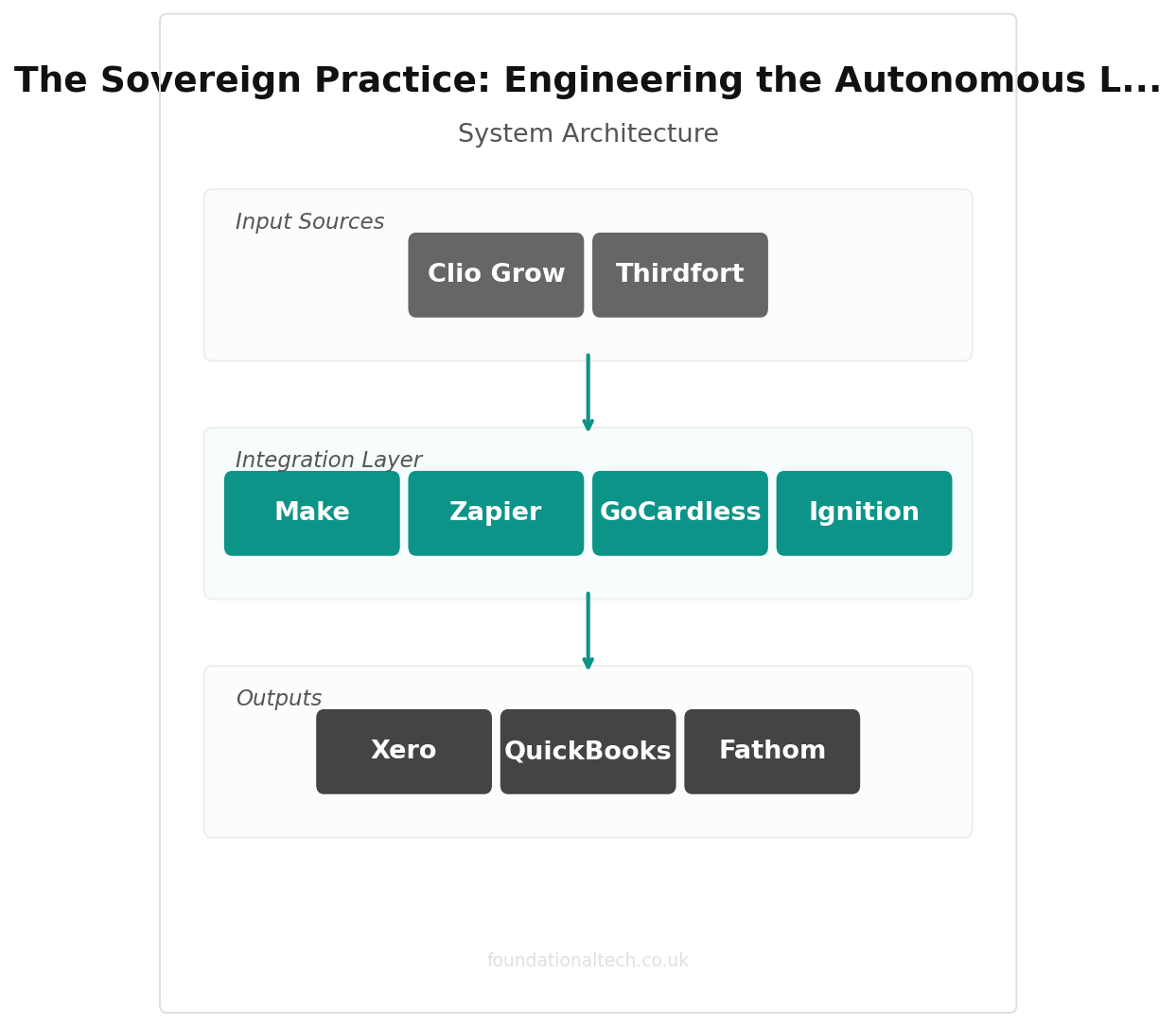
The Sovereign Stack has three layers, and understanding them is essential before you spend a single pound on implementation.
Layer 1: The Application Layer
These are the tools your team interacts with daily. For most UK firms I work with, the core stack looks like this:
- Practice management: Clio Manage (from £49/user/month) or Osprey Approach (from £55/user/month) — your operational spine
- Client intake and CRM: Clio Grow (from £29/user/month) — the front door
- Document management: NetDocuments (from £20/user/month) — the filing cabinet that never loses anything
- AML and identity verification: Thirdfort (£1.50–£15 per check depending on level) — your compliance gatekeeper
- Payments: GoCardless for recurring and one-off client payments — no more chasing cheques
- Financial intelligence: Fathom (from £12/month) — turns your accounts data into decisions
Individually, each of these is excellent. But individually, they are just better versions of the spreadsheets and paper files they replaced. The magic happens in Layer 2.
Layer 2: The Integration Hub
This is where the Sovereign Practice comes alive. The integration hub connects every application in Layer 1 so that data entered once flows everywhere it needs to go — automatically, instantly, and without error.
I use two platforms for this, depending on the firm’s complexity:
- Zapier (from £25/month) — best for straightforward, linear automations. If a new matter opens in Clio, create a folder in NetDocuments, trigger a Thirdfort AML check, and send the client a GoCardless payment link. One trigger, multiple actions, no code required.
- Make.com (from £8/month) — best for complex, branching workflows. If the matter is residential conveyancing, follow path A. If it is commercial, follow path B. If the client is a PEP, add enhanced due diligence steps. Make.com handles conditional logic that Zapier struggles with, and at a lower price point.
Most firms I build for end up using both. Zapier for the simple connections, Make.com for the sophisticated orchestration. The combined cost is typically under £40/month — less than a single hour of a trainee solicitor’s time.
Layer 3: The Data Warehouse
The final layer is the one most firms never reach, and it is the one that separates good practices from exceptional ones. Every action in Layer 1, connected through Layer 2, generates data. The data warehouse captures, stores, and visualises that data so that partners can make decisions based on evidence rather than instinct.
I use Microsoft Power BI for this. Most firms already have Microsoft 365 licences, which means Power BI Desktop is free. Connect it to Clio’s API, your Xero or QuickBooks feed (via Fathom), and your integration hub logs, and you have a living dashboard showing matters opened, matters closed, average time to completion, revenue per fee earner, client acquisition cost, and compliance status — all updated in real time.
The Autonomous Day: A Real-World Pipeline
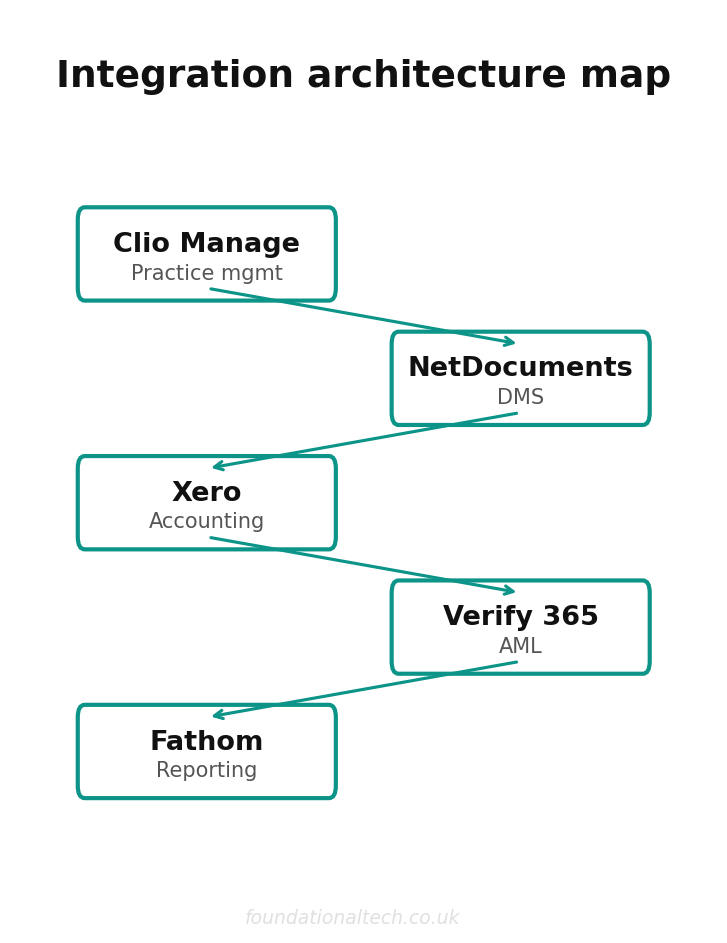
Theory is useful. Practical demonstration is better. Here is what a single day looks like inside a Sovereign Practice — a four-partner residential conveyancing firm I helped build in Leeds.
07:00 — The System Wakes Up
A scheduled Make.com scenario runs every morning at seven. It checks Clio Manage for any matters with key dates today — exchange deadlines, search expiry dates, mortgage offer expirations. It compiles these into a prioritised task list and sends it to each fee earner’s email and Microsoft Teams channel. No one had to ask. No one had to check a diary.
08:15 — New Enquiry Arrives
A potential client fills in the intake form on the firm’s website, powered by Clio Grow. Within ninety seconds, the following happens automatically:
- Clio Grow creates a new contact record and logs the enquiry source (Google Ads, referral, organic search)
- A Zapier trigger fires, sending the client a branded welcome email with the firm’s terms of engagement and a link to complete identity verification via Thirdfort
- A Make.com scenario creates a provisional matter folder in NetDocuments with the standard subfolder structure for residential conveyancing
- The enquiry appears on the Power BI dashboard under “Pipeline” with a timestamp, so the partners can see conversion rates in real time
Before this system existed, the same process took a receptionist twenty minutes of manual data entry and three separate logins. Multiply that by fifteen new enquiries per week, and you recover five hours of staff time — every single week.
10:30 — AML Check Completes
The client has completed their Thirdfort verification. Thirdfort sends a webhook to Make.com, which updates the matter status in Clio Manage from “Pending ID” to “Active.” If the check had flagged a PEP or sanctions match, the workflow would instead route to the firm’s MLRO with a structured alert — satisfying the firm’s obligations under the Money Laundering Regulations 2017 and the SRA’s guidance on risk-based AML compliance.
14:00 — Document Assembly
The fee earner needs to send the property information form to the client. She clicks a single button in Clio Manage. The integration hub pulls the client’s name, address, property details, and matter reference from Clio, populates the template stored in NetDocuments, and emails the completed document to the client for electronic signature. What used to involve opening four applications, copying data between them, and manually attaching a file now takes one click and twelve seconds.
17:30 — End of Day Reconciliation
GoCardless processes the day’s client account receipts automatically. A Zapier workflow matches each payment to its corresponding matter in Clio Manage and updates the billing record. Fathom pulls the updated financial data overnight and refreshes the firm’s cash flow forecast, profit margin analysis, and fee earner productivity metrics — all visible in Power BI the following morning.
The Result
This firm went from completing an average of 22 residential transactions per month to 34 — a 55 per cent increase — without hiring a single additional fee earner. Their average time from instruction to completion dropped from fourteen weeks to nine. Their SRA compliance audit, which previously required two weeks of frantic document gathering, now takes an afternoon because every record, every check, and every communication is indexed and searchable.
| Tool | Monthly Cost | Layer |
|---|---|---|
| Clio Manage | From £49/user/mo | Application — Practice management |
| Clio Grow | From £29/user/mo | Application — Client intake/CRM |
| NetDocuments | From £20/user/mo | Application — Document management |
| Thirdfort | £1.50-£15/check | Application — AML/ID verification |
| Xero | From £15/mo | Application — Office accounting |
| Zapier/Make | From £16/mo | Orchestration — Workflow automation |
What It Costs: The Full Sovereign Stack
Every managing partner I speak with asks the same question: what does all of this actually cost? Here is the breakdown for a four-user firm:
- Clio Manage — 4 users × £59/month = £236/month
- Clio Grow — 4 users × £29/month = £116/month
- NetDocuments — 4 users × £20/month = £80/month
- Thirdfort — approx. 60 checks/month × £3 avg. = £180/month
- GoCardless — transaction fees only, typically £40–£80/month
- Fathom — £12/month
- Zapier — Professional plan = £25/month
- Make.com — Core plan = £8/month
- Power BI — Desktop free with Microsoft 365; Pro at £7.50/user if needed = £0–£30/month
Total: approximately £700–£770 per month for the complete Sovereign Stack.
Compare that to the cost of the problems it eliminates. One full-time legal secretary in London costs £2,500–£3,000 per month including employment costs. The integration hub alone replaces fifteen to twenty hours of weekly data-entry work. The compliance automation reduces the risk of an SRA investigation, where fines regularly exceed £10,000 and reputational damage is incalculable. The financial intelligence layer means you catch cash flow problems in February, not when the tax bill arrives in July.
The Sovereign Stack does not cost £770 per month. It saves multiples of that figure. The real cost is choosing not to build it.
Implementation: The Five-Week Build
I do not recommend building the Sovereign Stack in one weekend. I recommend a phased five-week implementation that lets each layer prove itself before you add the next.
Week 1: Audit and Architecture
Map every process in your firm. Every intake step, every compliance check, every billing action. Identify where data is re-keyed manually. Identify where deadlines are tracked in heads rather than systems. This audit typically reveals between eight and fifteen manual processes that can be automated immediately.
Week 2: Core Platform Migration
Get Clio Manage and Clio Grow fully configured. Import your client data and matter history. Set up your matter templates, task workflows, and billing rates. This is the foundation — nothing else works without it.
Week 3: Document and Compliance Layer
Deploy NetDocuments with your folder structure templates. Configure Thirdfort integration for automated AML checks. Build your first Zapier workflow: new matter in Clio triggers folder creation in NetDocuments and AML check in Thirdfort. Test it with five real matters.
Week 4: Financial and Payment Layer
Connect GoCardless to Clio for automated payment collection. Set up Fathom and link it to your accounting platform. Build the Make.com scenarios for payment reconciliation and financial alerting. Configure notifications for overdue invoices and unusual account activity — essential for compliance with the SRA Accounts Rules 2019.
Week 5: Intelligence Layer
Build your Power BI dashboards. Connect the data sources. Create the views that matter to your firm: matter pipeline, fee earner utilisation, cash position, compliance status, client acquisition cost. Train your partners to read them. Schedule a weekly fifteen-minute dashboard review — and cancel the two-hour management meeting it replaces.
Why Architects Win Over Tool-Collectors
I have seen two types of law firm over the past five years. The first type buys tools enthusiastically. They have the best practice management system, the shiniest document platform, the most expensive CRM. But none of these tools talk to each other. Data still lives in silos. Partners still make decisions based on gut feeling and last month’s bank statement. The firm is digitised but not automated. It is a horse-drawn carriage with an electric motor bolted to the roof.
The second type thinks in systems. They ask not “what does this tool do?” but “how does this tool connect to everything else?” They spend less on software and more on architecture. They build once, properly, and then let the system run — freeing themselves to do the work that actually requires a trained legal mind.
The Solicitors Regulation Authority’s Technology and Innovation guidance explicitly encourages firms to adopt technology that improves client outcomes and operational efficiency, provided they maintain proper oversight and data protection under UK GDPR. The Sovereign Practice is not a radical departure from regulatory expectations. It is the logical fulfilment of them.
The autonomous law firm is not a fantasy. It is not even particularly difficult to build. It requires clarity of thought, a willingness to map your processes honestly, and about £770 per month. What it gives you back — time, accuracy, compliance confidence, and the ability to scale without proportionally scaling headcount — is worth immeasurably more.
Related guides: If you found this useful, see our guide on The Compliance Engine: De-Risking the Modern Law Firm with Automated Architecture and The Onboarding Fortress: Architecting the Automated Accounting Entry.
Stop collecting tools. Start building systems. That is the sovereign practice.