Key Takeaway
A decorator's best client loved the finished room and still forgot to pay. How automated deposits and Direct Debit solved the cash flow gap for good.
Her lounge was sage green. Not just any green — a Farrow & Ball shade she'd agonised over for three weeks, sending me swatches at eleven at night, asking whether "Bancha" would clash with her oak flooring. I painted it, twice, because the first coat pooled slightly under the window where the afternoon sun hit it. She stood in the doorway when I finished, hand over her mouth, and said it was the first room in her house that felt like hers rather than the previous owner's.
She meant every word of it. And then she didn't pay me for six weeks.
Not because she was trying to get one over on me. She wasn't hiding, she wasn't dodging calls, she genuinely loved that lounge. She just forgot. The invoice sat in an inbox buried under school emails, energy bill reminders, and a newsletter she'd never unsubscribed from. Every time I chased her — politely, because she was a genuinely lovely client and I didn't want to be the tradesman who ruins a good relationship over an invoice — she'd reply within the hour, mortified, promising to sort it "tonight." Then tonight would become Thursday, and Thursday would become "sorry, I'll do it at the weekend."
I want to be clear about what was happening, because I think most people in the trades misdiagnose this. It wasn't dishonesty. It was bandwidth. She had a job, two kids, and a house she was slowly falling in love with again. Paying me was never something she refused to do. It was something she never got round to doing, because nothing in her day forced the moment.
Here's the uncomfortable parallel I have to own up to. For the better part of a year I told myself I was "getting round to" learning how to use AI tools properly in my own business — automating quotes, cleaning up my admin, all of it. I bought the courses. I bookmarked the YouTube tutorials. I even had a note in my phone titled "Sort out systems" that sat there for eleven months, untouched, while I kept doing everything the way I'd always done it: manually, from memory, chasing myself as much as I chased my clients. Nobody was forcing the moment for me either. That's the thing about "I'll get round to it" — it's not laziness, it's the absence of a trigger. Remove the friction, and behaviour changes almost instantly. Leave the friction in place, and good intentions rot on a shelf, whether that's a client's unpaid invoice or a tradesman's unopened admin folder.
That's what changed how I run payments now. I stopped waiting for people — including myself — to remember things. I built systems that don't rely on memory at all.
The real cost of "I'll sort it later"
Let's put some numbers on this, because "chasing payments is annoying" undersells what it actually does to a decorating business. A typical UK decorator or painter is charging somewhere between £200 and £350 a day, and a mid-sized domestic job — two bedrooms, a hallway, a lounge like the one above — usually lands somewhere between £800 and £2,000 once materials are in.
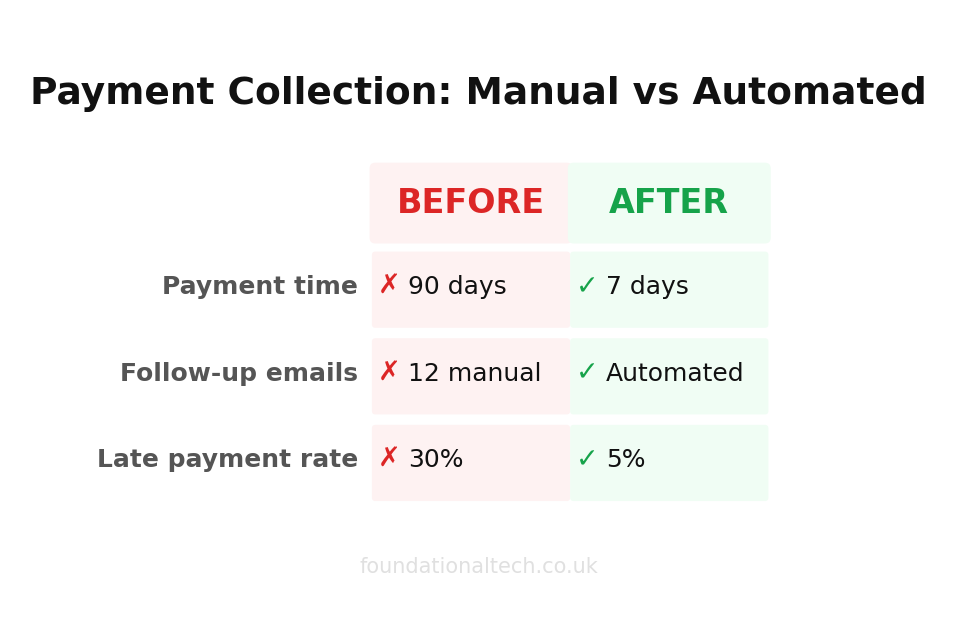
Now imagine three or four of those jobs sitting unpaid at any given time, which is completely normal if you're not actively managing it. That's £3,000-£6,000 of your own labour and materials sitting in someone else's bank account while you're still buying paint, still paying your own suppliers, and still covering fuel and van costs out of pocket. The Federation of Master Builders and various trade insurers have flagged late payment as one of the top three reasons small building and decorating firms fail — not lack of work, not bad workmanship, but cash flow strangled by invoices that sit unpaid for 30, 60, sometimes 90 days.
And the chasing itself has a cost that never shows up on a spreadsheet. Every phone call, every "just following up" text, every awkward moment where you have to decide whether to mention money to someone whose house you're still standing in — that's emotional labour and it's time you're not spending quoting the next job.
Step one: take a deposit before you pick up a brush
The single biggest shift I made was refusing to start a job without a deposit. This isn't about distrust — it's about making payment part of the booking process rather than an afterthought at the end.
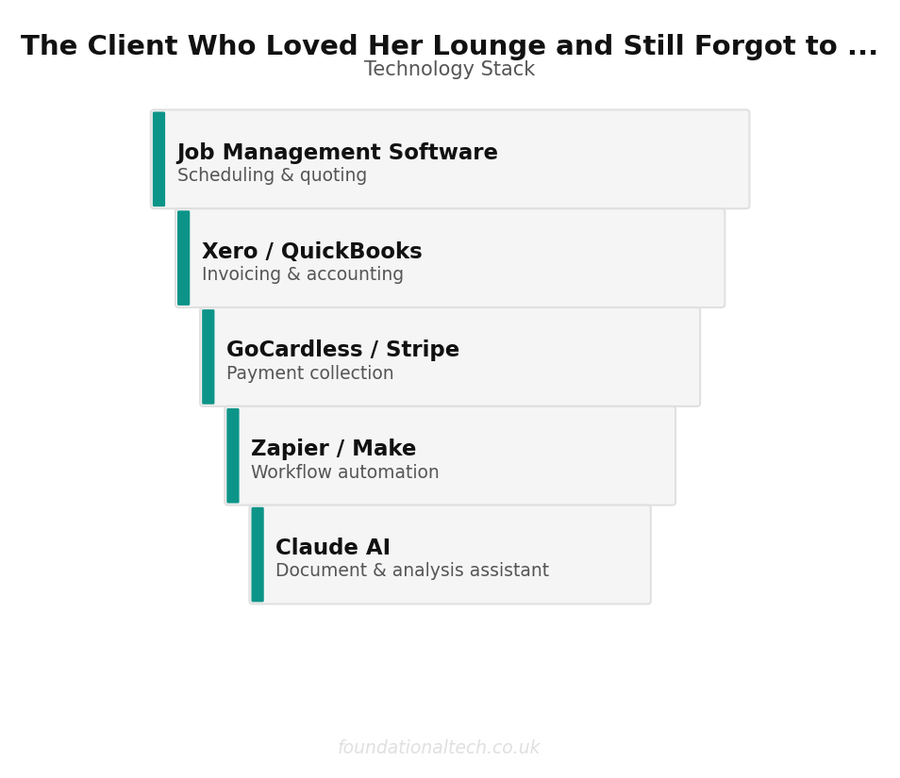
I now take 25-30% of the total job value at the point of booking, and I've automated it so it happens without me having to ask twice:
- Stripe Payment Links — I generate a simple payment link for the deposit amount and send it in the same message as the written quote. No app, no account needed on the client's end, just a card payment page. Stripe charges 1.5% + 20p per UK card transaction, so on a £2,000 job with a £500 deposit, that's roughly £7.20 in fees — trivial against the certainty of having the job actually committed to.
- GoCardless instant bank pay — for clients who'd rather not put a large deposit on a card, GoCardless lets them pay directly from their bank account with a one-off authorisation. It settles faster than a standard bank transfer for the client and costs 1% + 20p, capped at £4 per transaction — cheaper than card fees on anything above about £400.
- Straightforward bank transfer — some clients, particularly older ones, still prefer this. I keep it as an option but I always send my bank details alongside a clear reference and a deadline, because an open-ended "whenever's convenient" is exactly the trap that caught me with the sage green lounge.
The psychological effect of a deposit matters as much as the cash flow benefit. Once someone has paid something, the job feels real to them. It moves from "a nice idea for the lounge" to "a thing I've committed money to," and that shift in their head makes the final invoice far less likely to be forgotten.
Step two: the final walkthrough is not the end of the job — it's the moment you invoice
This is the habit that changed everything for me, and it costs nothing to implement. The final invoice does not go out that evening from your kitchen table. It goes out standing in the room, with the client, before you've packed the van.
My workflow now looks like this:
- Do the final walkthrough with the client while the paint is still fresh and they're still glowing about the colour.
- Open the invoicing app on my phone right there — I use Xero, though FreeAgent does the same job — and generate the final invoice with the balance owed, minus the deposit already paid.
- Attach a payment link directly to that invoice (both Xero and FreeAgent support this natively through their Stripe and GoCardless integrations).
- Send it to the client's phone or email while we're both still standing in the lounge, and ask them, casually, to have a quick look and confirm the amount looks right.
- Leave. Don't chase that evening. Let the automated reminder sequence do the rest.
The difference this makes is enormous. You are no longer relying on a client's memory once they've walked back into the chaos of their normal week. You're catching the moment of maximum goodwill — the room looks incredible, they're pleased, you're both standing there — and turning it directly into a payment action before anything competes for their attention.
Step three: automate the reminders so you never have to send an awkward text again
Even with a payment link on the final invoice, some clients still won't pay immediately. That's fine — this is where automated reminders do the emotional labour that used to fall on me.
Both of the accounting platforms I'd recommend to a solo decorator or a small crew have this built in:
- Xero (£15/month on the Starter plan) — you can set automatic invoice reminders at, say, 3 days before due, on the due date, and 7 days overdue. The email comes from your business, in your tone, and you never have to lift a finger. Xero also lets you attach the online payment options directly so the reminder itself contains a "Pay now" button.
- FreeAgent (£14.50/month for sole traders, often free if you bank with NatWest, RBS, Mettle or Ulster Bank) — similarly supports automated chase emails on a schedule you set once and never touch again. FreeAgent's dashboard is particularly good for a one-person operation because it also handles your Self Assessment prep, which most decorators are doing badly or not at all.
The key point is that the reminder is no longer a decision you make. It's not you weighing up whether today is the day you nag the sage-green-lounge client again. It's a system that fires on a schedule regardless of how you're feeling about the conversation, which removes the awkwardness entirely — the client is being reminded by software, not being chased by you personally.
Step four: GoCardless direct debit for repeat and ongoing clients
If you do maintenance work, ongoing decorating contracts, or repeat seasonal work for landlords and letting agents, GoCardless direct debit is worth setting up properly rather than relying on one-off payment links every time.
Setting it up takes about twenty minutes:
- Create a GoCardless account (the basic plan has no monthly fee — you only pay per transaction, 1% + 20p, capped at £4).
- Connect it to Xero or FreeAgent, both of which integrate directly.
- Send the client a one-time mandate link — they authorise it once, the same way they'd set up a direct debit for a gym membership or a phone contract.
- From that point on, every invoice you raise for that client can be collected automatically on the due date, with no card details to re-enter and no reminder needed at all.
This is the version of "never having to ask" that I was aiming for the whole time. For clients with recurring work, it removes the payment conversation from the relationship entirely.
Step five: let a job management tool run the whole chain
If you want the quote-to-deposit-to-final-invoice sequence to run itself without you manually triggering each step, it's worth looking at trade-specific job management software rather than stitching together separate tools:
- YourTradebase (from £15/month) — built specifically for smaller trade businesses, it handles quoting, scheduling, deposit collection and invoicing in one chain, so the deposit request goes out automatically the moment a quote is accepted.
- Tradify (£29.50/month) — a step up in scope, with job costing and materials tracking alongside the payment automation, better suited if you're running a small crew rather than working solo.
What it costs to run this properly, all in, for a solo decorator: FreeAgent or Xero at roughly £15/month, plus GoCardless and Stripe fees that only apply when money is actually moving (so they scale with your income rather than sitting as a fixed cost), comes to somewhere around £15-£30 a month in software plus a few pounds in transaction fees per job. Against £3,000-£6,000 sitting unpaid at any given time in the old system, it isn't a close call.
90 days to get paid
for a £3,000 decorating job the client was genuinely happy with
What actually changed
I still think about that sage green lounge. Not because the client did anything wrong — she didn't, and she's still a client I do work for today — but because she taught me something I'd been avoiding admitting about my own business. People don't withhold payment out of malice nearly as often as they withhold it out of sheer busyness, and busyness is not something you fix by asking more nicely or chasing more often.
You fix it by removing the moment where a decision has to be made at all. A deposit taken at booking removes the decision to commit. An invoice sent on-site with a payment link removes the decision to log in later and dig out the paperwork. An automated reminder removes the decision to reply to my text tonight versus at the weekend. A direct debit mandate removes the decision altogether.
Related guides: If you found this useful, see our guide on How to Automate a UK Painting and Decorating Business: The Complete Software Stack for Solo Decorators and Small Teams (2026) and How UK Painters and Decorators Are Using AI to Quote Faster (Without Sounding Like a Template).
None of this required me to become a different kind of tradesman, and none of it required my clients to become more organised than they naturally are. It just took the systems I'd been putting off for eleven months and finally put them between the job finishing and the money arriving, instead of leaving that gap open for good intentions to fall into.