Key Takeaway
A UK electrician was certain AI would replace him. Instead, it replaced 10 hours of weekly admin. A real-world automation story from a working sparky.
The first thing Mark said to me, before I'd even got my laptop out, was: "I'll tell you now, I'm not interested in a robot doing my certs."
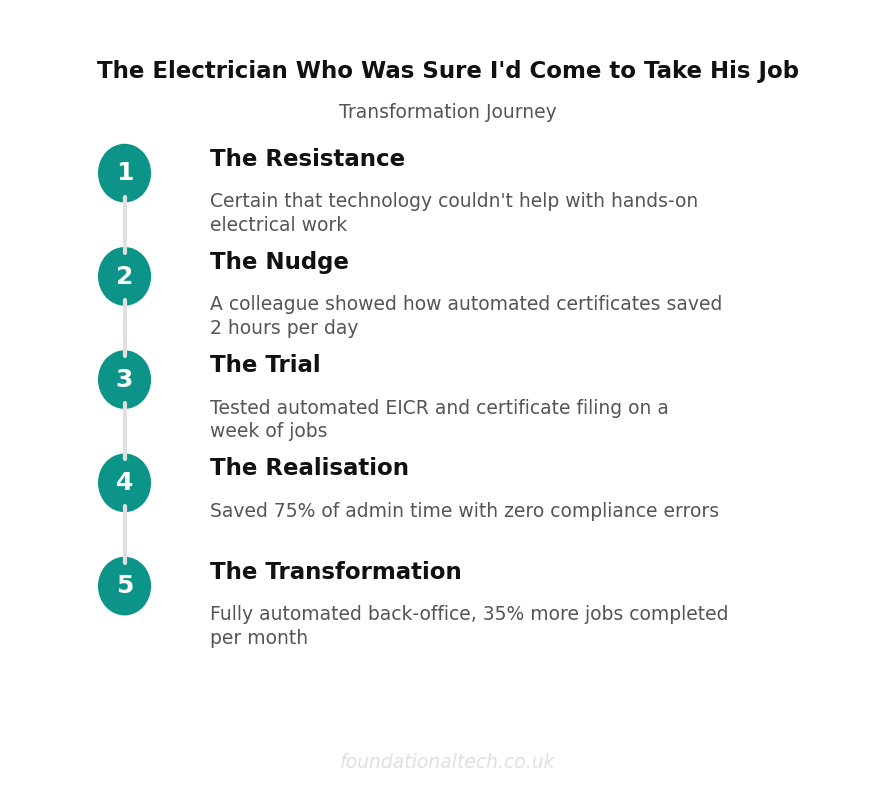
He said it with his arms folded. Twenty-two years a qualified electrician, NICEIC registered, two vans. His wife had booked the call without telling him exactly what I did, and he'd spent the morning deciding I was a threat. You could see it on him. He thought I'd turned up to explain how some app was going to make him obsolete.
I get this a lot now. More than the cash-flow stuff, more than the tax stuff. The folded arms. The slightly defensive jaw. People have read the headlines — AI is coming for your job — and somewhere in the back of their mind they've decided that when the reckoning comes, it'll come dressed as a man with a laptop and a friendly manner. And here I was.
So I didn't open the laptop. I asked him about his week instead.
The thing he was actually angry about
It took him about ninety seconds to stop talking about AI and start talking about Sunday nights.
Because that's where the real anger was. Not at robots. At the kitchen table at half nine on a Sunday, working through a stack of EICRs he'd done that week — observations scribbled on the back of the schedule, codes to assign, the NICEIC paperwork, the certificate to type up clean and email to the landlord. The actual inspection had taken him forty minutes. The write-up was taking him most of the evening, days later, when he could barely remember which board was which.
He told me he'd missed his daughter's thing at school that week. Couldn't even remember what the thing was. But he remembered why — he'd been "catching up on certs."
And here's what got me. He said it like it was his fault. Like a better, more organised electrician wouldn't be in this mess. Twenty-two years of genuine skill, and he was sitting there quietly ashamed about an admin pile that has nothing to do with whether he's any good with his hands.
That's the bit that always gets me, in every trade I walk into. The skilled people have somehow been convinced that the paperwork drowning them is a personal failing rather than a design flaw in how the whole job is set up.
Why I actually understood him
I didn't tell him this in the moment, but I knew exactly the feeling he was describing — the one where you're good at the real thing and humiliated by the admin around it. Because a couple of years ago I'd been the one with my arms folded.
When I first started seriously learning this stuff — the automation, the AI tools, the way you wire one system into another — I felt like an idiot. I think people assume I found it easy. I didn't. I was a qualified accountant in my late thirties, respected by my clients, and there I was at eleven at night watching beginner tutorials and not understanding the words. Things a teenager would've picked up in an afternoon were taking me a week. Some nights I closed the laptop genuinely wondering if I'd left it too late.
What I was really feeling — I can see it now — was the specific fear of being a beginner again after years of being the expert. It's a horrible feeling and nobody warns you about it. When you've spent two decades being the person who knows, going back to being the person who doesn't is a kind of grief. You don't just have to learn the thing. You have to survive being bad at something in front of yourself.
That's what Mark was protecting himself from, with the folded arms. Not the technology. The humiliation of starting over at forty-six.
What I've learned about starting over
Here's the thing I wish someone had said to me at eleven at night in 2024, and the thing I ended up saying to Mark.
You're not starting over. You're relocating.
Everything Mark knows about a consumer unit, about Part P, about what a C2 actually means versus a C3, about the look of a board that's been bodged by the last bloke — none of that is going anywhere. No machine is doing that. That knowledge took twenty-two years to build and it's the entire reason anyone pays him. The skill is safe. It was always safe.
What's changing isn't the skill. It's the wrapper around it — the typing, the copying of the same address into four places, the certificate that has to be produced and chased and filed. And the wonderful, almost unfair truth is that the wrapper is the easy part to hand over. Far easier than learning to be an electrician. Far easier, even, than what I had to learn.
My decades of accountancy didn't become worthless when the tools arrived. They became the most valuable thing I had — because the tool is stupid on its own. It needs someone who knows what a healthy set of books looks like, what HMRC will question, what matters. The expertise didn't transfer out. It moved up, to sit on top of the machine and steer it.
Mark's twenty-two years do the same. The system can draft the EICR, pull the observations into the right format, produce the certificate the second he leaves site. But it's worthless without an electrician who knows what he's looking at. He's not being replaced by it. He's the only reason it's worth anything.
Where he started
We didn't do a grand transformation. I've stopped believing in those.
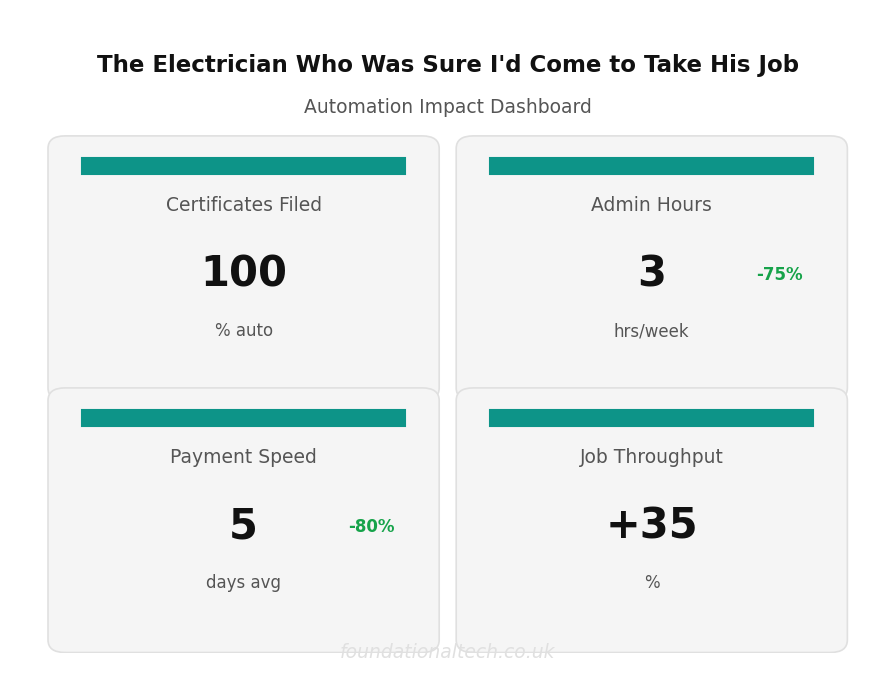
We picked the single thing he dreaded most — the Sunday-night cert write-up — and we fixed only that. (If you want the full picture of what that transformation looks like end-to-end, read how one UK electrician went from 9pm paperwork to paid in 3 days.) The inspection notes now go into his phone on site, in the order he actually walks a property. The certificate builds itself from those notes before he's back in the van, in proper BS 7671 format, ready to email to the landlord while the job's still warm. The Sunday pile just... stopped existing.
One task. The one that had cost him his daughter's school thing. That's where everyone should start — not with the whole business, not with a master plan, but with the one job you hate most, the one you've quietly decided is your own fault. Knock that one over and the fear changes shape. It stops being the machines are coming for me and becomes oh — that was the bit I never should've been doing by hand.
The Tools That Replace the Kitchen Table, Not the Toolbag
Here's what Mark didn't know — and what most electricians still don't — the tools that kill the Sunday-night admin pile aren't complicated, they aren't expensive, and they don't touch the actual electrical work. They replace the kitchen table, not the toolbag.
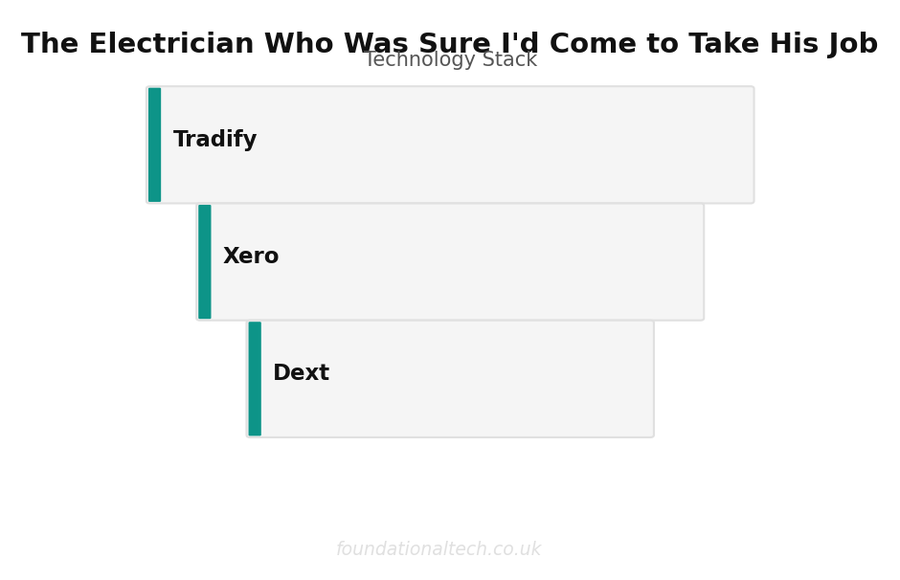
Start with the certs, because that's where the pain lives. iCertifi (from £9.99/month) is what most sparks reach for first — it produces BS 7671-compliant certificates directly from on-site data entry. You walk through the boards, tap in your observations as you go, and the certificate builds itself in the background. By the time you're back in the van, the EICR is formatted, numbered, and ready to email to the landlord. No Sunday night. No deciphering your own handwriting three days later. Cert Simply (from £7.99/month) does the same job at a lower price point and is particularly popular with sole traders who do a lot of landlord work. EasyCert (from £6.99/month) rounds out the options — slightly simpler interface, same BS 7671 output.
Then there's the job management layer. Tradify (from £29.50/user/month) handles quoting, scheduling, and invoicing from your phone. You quote on site, the customer accepts digitally, you schedule the job, you complete it, you invoice — all from the same app, often while you're still in the customer's driveway. It connects directly to Xero, so every invoice flows straight into your accounts without you touching a spreadsheet.
Receipt capture is the one nobody thinks about until tax return season arrives like a freight train. Dext (from £24/month) turns your phone camera into a bookkeeping tool. Every time you pick up cable from the wholesaler or fill up the van, photograph the receipt. Dext reads it, categorises it, and pushes it into Xero. No more shoeboxes. No more "I think that was a business expense but I can't prove it."
For the accounts themselves, Xero (from £15/month) handles bank feeds, VAT returns, and Making Tax Digital compliance. Your bank transactions appear automatically, matched against invoices and receipts. When your quarterly VAT return is due, the numbers are already there — you're not spending a weekend reconstructing three months of activity from memory and bank statements.
And for getting paid — GoCardless handles Direct Debit collection for maintenance contracts and regular clients, so the money arrives on a fixed date without you sending a single chasing text. For one-off jobs, Stripe payment links let you text the customer a "Pay Now" link before you've left the street. Most people pay within the hour.
Total monthly cost for a sole trader electrician running the full stack: roughly £90–120/month. That's less than the cost of a single rewire job. And it replaces every hour you currently spend at the kitchen table.
Cost-Benefit: The Numbers Mark Didn't Believe
When I walked Mark through the maths, he went quiet for about thirty seconds. Then he said, "That can't be right." It was.
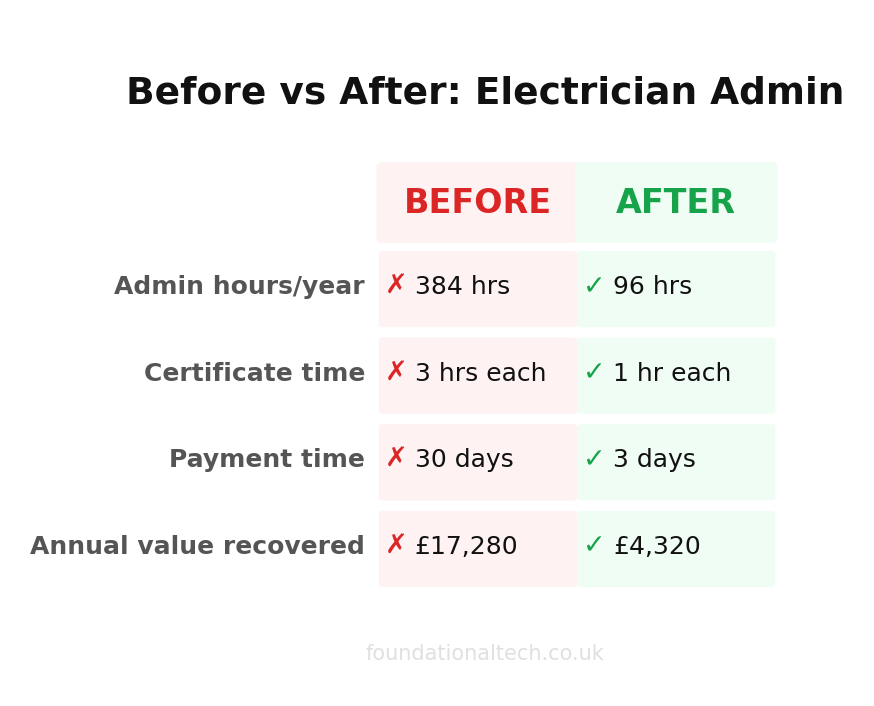
Let's be conservative about it. Sunday cert write-ups: 3 hours per week, 48 working weeks a year — that's 144 hours. Quote preparation — measuring up, writing it out, pricing materials, emailing it over — 2 hours a week, or 96 hours a year. Invoice chasing — the texts, the follow-up calls, the awkward conversations — 1 hour a week, 48 hours a year. And the general bookkeeping: sorting receipts, reconciling the bank, preparing for the VAT return — another 2 hours a week, 96 hours a year.
Add it up: 384 hours a year. That's roughly 48 working days. Nearly ten full weeks of your year spent on admin that has nothing to do with electrical work.
Now price it. The average UK electrician's effective hourly rate — what you'd earn if you were on a job instead of at the kitchen table — sits around £45/hour. Multiply that by 384 hours and you get £17,280 in lost earning potential every single year. Not theoretical money. Real jobs you could have done, real invoices you could have sent, real evenings you could have spent with your family.
The full automation stack — certification app, Tradify, Dext, Xero, payment tools — costs roughly £1,200–1,440 per year. Call it £120 a month at the top end.
Net benefit: over £15,000 a year in reclaimed billing time. And your Sundays back. Mark stared at the numbers and said something I hear a lot: "I knew it was bad, I just didn't know it was that bad."
384 admin hours/year recovered
by an electrician who was sure automation meant losing his job
Getting Started: The One-Tool-Per-Week Plan
The mistake most people make is trying to set everything up at once. You clear a Saturday, install five apps, connect three accounts, get confused by the third integration, and quietly go back to the notepad. I've watched it happen dozens of times. So here's what I told Mark, and what I tell every electrician: one tool per week, starting with the thing you hate most.
Week 1: Sign up for a certification app. iCertifi or Cert Simply — pick whichever interface you prefer (both offer free trials). Do your next EICR on it instead of paper. Just one. That's the quick win that builds momentum. When you email the certificate to the landlord from the van and realise you don't have a Sunday-night session waiting for you, something shifts in your head.
Week 2: Set up Xero and connect your bank feed. This takes about 20 minutes. Even if you do nothing else with Xero for a month, the bank feed alone saves hours of statement matching. Your transactions appear automatically, and you start to see your cash flow in real time instead of guessing at it.
Week 3: Install Dext on your phone. From now on, every receipt gets photographed before it goes in the van — or more likely, before it disappears into the van forever. They'll auto-appear in Xero, categorised and ready. Tax return season stops being an archaeological dig.
Week 4: Set up Tradify. Import your customer list, create your first digital quote. Next time someone asks for a price on a consumer unit change, do it on the app instead of a notepad. The quote goes out looking professional, the customer accepts with a tap, and the job flows into your schedule automatically.
Don't try to do it all at once. And don't beat yourself up if week 3 slips to week 4. The point is forward motion, not perfection. Mark's exact words after week 2: "Why did I think this would be hard?"
By the end of the call Mark had unfolded his arms and was holding his phone out, asking me to set it up there and then. Same man. Same fear, an hour earlier. The only thing that had changed was that he'd stopped believing the skill and the admin were the same thing.
This week on Foundational Tech I published ten guides for electricians covering exactly this world — start with the complete guide to automating an electrical business or the step-by-step integration map for Tradify, Xero and Dext — Tradify, Xero, Dext and the certificate apps that turn the Sunday-night EICR pile into a job that finishes when you leave site. If you know a spark who's brilliant on the tools and drowning at the kitchen table, that's who they're for.
When did you last have to be a beginner at something after years of being the expert — and how did it feel? I think that fear, the going-back-to-not-knowing, is the real thing holding most people back, far more than the technology itself. Hit reply or leave a comment. I read every one.