Key Takeaway
End the billable bottleneck in UK law firms. Build a frictionless tech stack connecting practice management, billing, DMS, client portals, and reporting.
The bottleneck nobody budgets for
Every managing partner I sit down with tells me the same story. Fee earners are busy — diaries full, files moving, clients (mostly) happy — yet the firm's realisation rate limps along at 80 to 85 per cent. That gap between time worked and time actually billed isn't a productivity problem. It's an architecture problem. The tools a typical high street or mid-sized firm runs on were never designed to talk to each other, and the person paying for that silence is whoever reconciles the client account at month end.
80-85%
Typical law firm realisation rate — the gap between time worked and time billed is an architecture problem
I've spent the last two years pulling apart law firm tech stacks — sometimes to fix a specific pain point, sometimes because a firm has had an SRA inspection go badly and wants to make sure it never happens again. What I keep finding is a stack built from good individual products stitched together with manual re-entry: time recorded on paper or in Word, transferred into a billing spreadsheet, then rekeyed into accounts software, then rekeyed again for the VAT return. Every rekeying is a place where fees leak and where a compliance breach can quietly happen.
This article is about what replaces that stack: a small number of API-linked, UK-compliant tools that remove the rekeying entirely, keep client money correctly separated under the SRA Accounts Rules 2019, and — as a direct consequence — push realisation rates up rather than just hoping fee earners remember to log their time.
The SRA Accounts Rules 2019: what the software actually has to do
Before choosing any product, it's worth being precise about what the regulator requires, because every tool recommendation in this piece is really a compliance decision wearing a technology costume.
Rule 2: keep client money separate
Rule 2 of the SRA Accounts Rules 2019 is the foundation everything else sits on: client money must be kept separate from the firm's own money, held in a client account at a bank or building society, and used only for its intended purpose. This sounds obvious until you look at how many firms still run client and office ledgers in the same spreadsheet tab, distinguished only by a colour code someone forgot to apply consistently. Software that can't enforce a hard separation between client and office ledgers — with its own chart of accounts, its own bank feed, and its own audit trail — isn't SRA-compliant software, whatever the marketing says.
Rule 4: prior authority for mixed payments
Rule 4 deals with the situation every conveyancer knows well: a payment arrives, or needs to go out, that covers both client money and the firm's own fees or disbursements. The rule requires that money is only paid from the client account for its intended purpose, and that where a payment relates to both client and office money, the firm has proper authority and process for splitting it — with the split reflected accurately in both ledgers before the money moves. Manually splitting a mixed receipt in a spreadsheet, then rekeying two separate entries into accounts software, is exactly the kind of step where errors creep in and where an SRA inspector will ask pointed questions.
Rule 8: client accounting records
Rule 8 requires firms to keep accurate, contemporaneous records of all dealings with client money, including a client ledger for each client showing all transactions, a central record of all client money held, and reconciliations of the client account against those records at least every five weeks. "Contemporaneous" is the word that catches firms out. A reconciliation done properly on the day, from a system that has already matched receipts and payments, is a different exercise from a reconciliation done under deadline pressure from three separate spreadsheets that don't quite agree.
The pattern I see in every SRA accounts breach I've been asked to help clean up is the same: not fraud, but drift — small manual errors compounding over months because no system was forcing reconciliation to happen at the point of transaction rather than at the point of panic.
Clio Manage as the compliance backbone
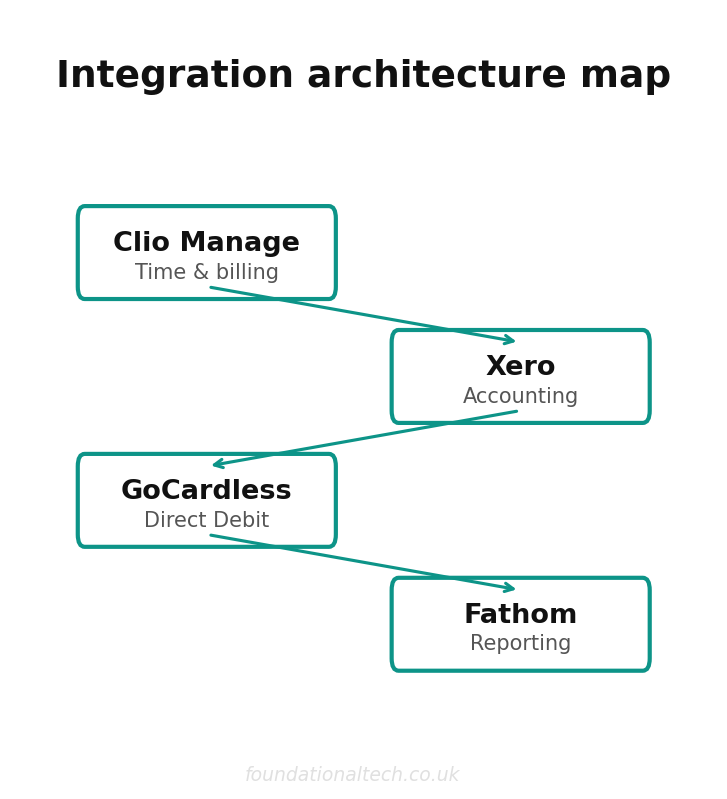
Clio Manage has become the default choice for UK firms rebuilding their stack, and it's worth being specific about why, because "practice management software" covers products with wildly different levels of actual accounting rigour. As of 2026, Clio's UK pricing runs across three tiers: EssentialAI at £49 per user per month, AdvancedAI at £89, and CompleteAI at £119, all billed annually. The jump between tiers is mostly about automation depth — AdvancedAI adds more sophisticated billing and reporting workflows, CompleteAI adds the fuller AI drafting and client intake automation — but even the entry tier gives you the trust accounting structure that actually matters for SRA compliance.
The trust accounting features that do the heavy lifting:
- Segregated client and office ledgers that are structurally incapable of being merged, satisfying Rule 2 by design rather than by staff discipline
- Three-way reconciliation — matching the client account bank balance, the client ledger totals, and the individual client balances — run as a guided process rather than a spreadsheet exercise, which turns the Rule 8 five-week reconciliation from a half-day dread into a twenty-minute check
- Automated alerts for trust shortfalls, flagging the moment a client ledger would go negative, before the payment is made rather than after
- Split billing and payment allocation that handles Rule 4 mixed payments as a structured workflow — the system prompts for the split between client and office money at the point of entry, and records the authority for it
- A full audit trail on every transaction, timestamped and attributed to the user who entered it, which is precisely what an SRA inspector or a forensic accountant wants to see first
None of this is exotic. It's what a client accounting system should have always done. What's changed is that it now sits inside the same platform as matter management, time recording, and billing, so the data doesn't have to survive three separate exports and imports to stay accurate.
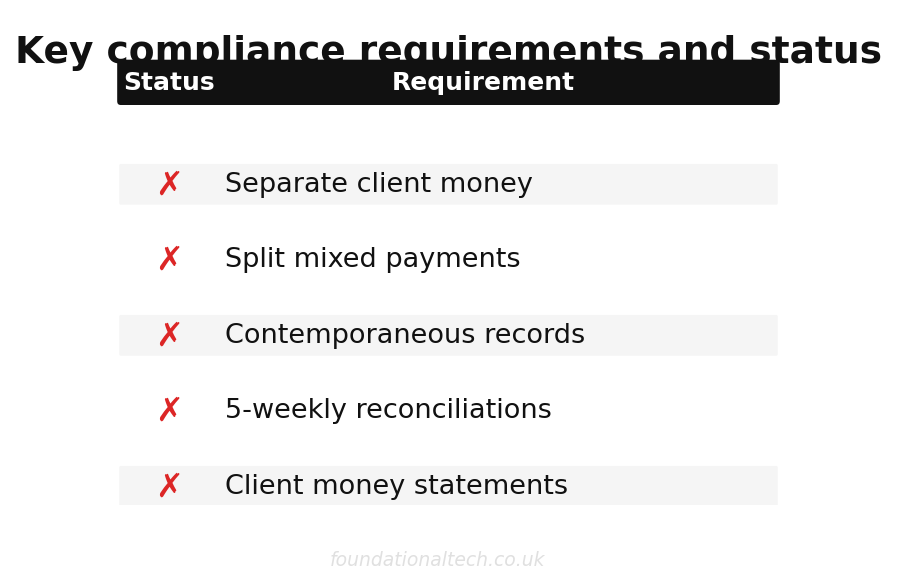
| SRA Rule | Requirement | Software Solution |
|---|---|---|
| Rule 2 | Separate client money | Clio dual-ledger with hard separation |
| Rule 4 | Split mixed payments | Automated ledger splitting |
| Rule 8 | Contemporaneous records | Real-time bank feed reconciliation |
| Rule 8.3 | 5-weekly reconciliations | Automated reconciliation reports |
| Rule 8.4 | Client money statements | Auto-generated from Clio ledger |
Passive time tracking and the realisation rate problem
Here's the number that should worry every partner more than it usually does: firms running manual time recording — fee earners typing entries into a timesheet at the end of the day, or worse, at the end of the week — typically realise 80 to 85 per cent of the time actually worked. The rest simply isn't captured. A fifteen-minute call that doesn't get logged because the fee earner moved straight into the next task. A document review done between meetings that gets rounded down from memory, badly. Over a year, across a team of ten fee earners, that gap is not a rounding error — it's often the difference between a firm's target profit per equity partner and a disappointing one.
Passive time tracking tools close that gap by capturing activity automatically rather than relying on memory. WiseTime, priced at roughly £15 to £25 per user per month depending on firm size and integration package, runs quietly in the background, observing which documents, emails, and applications a fee earner is working in and building a private activity log. Nothing is billed automatically — the fee earner reviews and confirms entries — but the starting point is a complete, accurate record rather than a blank timesheet and a guilty conscience. Firms that move from manual to passive tracking, paired with Clio's billing workflow, commonly see realisation rates move from the low 80s into the 90 to 95 per cent range within two or three billing cycles, simply because the time was always being worked — it just wasn't being captured.
The integration matters as much as the capture. WiseTime and similar tools sync directly into Clio's matter records via API, so confirmed time entries land against the correct client and matter without anyone rekeying anything. That single integration point removes what used to be a Friday afternoon ritual of chasing fee earners for their timesheets.
Xero for the office account
Client accounting sits inside Clio, but the firm's own operating finances — payroll, rent, supplier invoices, VAT returns, management accounts — belong in a proper office accounting package, and Xero has become the standard pairing for UK firms on this stack. Pricing runs from around £15 to £30 a month depending on the plan (Ignite through to Comprehensive), which is trivial against what it saves in bookkeeping time.
The point of pairing Xero with Clio isn't duplication, it's separation done properly. Billed fees flow from Clio into Xero as sales invoices via the native integration, so the firm's revenue recognition and VAT position are always current without a bookkeeper rekeying invoice data. Office account transactions — the firm's own bank account, not the client account — reconcile inside Xero using its bank feed, giving the finance team a live view of firm profitability that sits entirely separate from client money, which is exactly the separation Rule 2 requires.
Compliant payment processing
The last piece is how money actually moves. UK firms have converged on two options: LawPay (now part of the MyCase/AffiniPay stable and increasingly available to UK firms through Clio's payments integration) and Stripe configured specifically for legal trust accounting. Both matter because ordinary payment processors are a compliance trap for law firms — a standard merchant account deducts its processing fee from the gross payment before it lands, which means a client payment into a trust account arrives short, and the firm has technically failed to hold the full amount of client money it was entrusted with. Legal-specific payment processing separates fees so the full client payment lands in the client account and the processing fee is deducted from the office account instead. It sounds like a technicality; to an SRA inspector it's the difference between compliant and non-compliant.
Clio Payments, built on this same principle and integrated natively, typically runs at standard card processing rates (around 1.4 to 2.9 per cent depending on card type) with no separate monthly platform fee for firms already on a Clio plan.
A real workflow, start to finish
It's easier to see how this fits together as a single client journey than as a list of features. Here's a conveyancing matter run through the integrated stack:
- Intake: the client is set up in Clio via an online intake form; conflict checks and ID verification run automatically, and a matter is opened with the correct fee structure attached.
- Funds received: the client sends the deposit; it lands via Clio Payments directly into the client account ledger, correctly separated from the firm's fees under Rule 2, with the transaction timestamped automatically.
- Work in progress: the fee earner works the file. WiseTime captures document time, call time, and drafting time passively in the background throughout.
- Time review: at the end of each day, the fee earner spends five minutes confirming WiseTime's captured entries inside Clio, rather than reconstructing the day from memory.
- Disbursements and mixed payments: a search fee is paid from the client account alongside the firm's own admin fee. Clio's split billing workflow records the Rule 4 authority and posts the correct amounts to each ledger in the same action.
- Completion and billing: the matter completes. Clio generates a final bill from the confirmed time entries and disbursements, automatically distinguishing what's payable from the client account against what's owed to the firm.
- Trust reconciliation: the client ledger clears to zero as funds transfer; Clio's three-way reconciliation confirms the client account bank balance matches the ledger totals, satisfying the Rule 8 record-keeping requirement without a separate spreadsheet exercise.
- Revenue posting: the billed fee flows into Xero as a sales invoice, landing in the firm's management accounts and VAT position automatically.
Nobody rekeyed a figure at any stage. That's the actual point of the exercise — not that any single tool is clever, but that the handoffs between them don't require a human to transcribe numbers from one system into another.
What it costs
For a firm of, say, eight fee earners, the monthly cost of this stack looks roughly like this:
- Clio Manage (AdvancedAI, 8 users): £89 × 8 = £712/month
- WiseTime passive time tracking (8 users): £20 × 8 = £160/month
- Xero (Comprehensive plan): approximately £42/month
- Payment processing: variable, roughly 1.5–2.5 per cent of processed client payments, deducted from the office account, not the client account
That's a fixed cost of roughly £900 a month before transaction fees — against a realisation rate improvement that, on a firm billing £150 an hour across eight fee earners working reasonably full diaries, is often worth several thousand pounds a month in previously uncaptured time. The software isn't the expensive part of running a firm. The manual reconciliation, the rekeying, and the time nobody remembered to log always were.
The regulatory case for making this change and the commercial case for making it turn out, in nearly every firm I've looked at, to point in exactly the same direction.
For the full architectural vision, read The Sovereign Practice: Engineering the Autonomous Law Firm.