Key Takeaway
Stop chasing late payments as a UK window & door installer. Automated invoicing, deposits and direct debit in 2026.
A homeowner in Chorley signs on the kitchen table on a Tuesday afternoon. Bespoke aluminium bifold doors, five panes, anthracite grey, £6,400. She's excited, the installer's excited, and rather than let a good order sit around, he calls the fabricator that evening and gets the frames into the next cutting run. Twelve days later she rings back. She's changed her mind — nothing wrong with the quote, she and her husband just aren't sure any more. She's entitled to say that, and she's entitled to every penny of her £1,920 deposit back. She signed the contract in her own home, and the law gives her fourteen days to walk away for no reason at all. The frames are already being cut to a non-standard opening. Nobody else wants a five-pane anthracite bifold sized for a 1970s semi in Chorley.
That's not a late-paying customer. That's not even a bad customer. It's a business that spent supplier money before the customer's legal right to change their mind had actually expired — and it's the risk that sits underneath every other cash flow problem in this trade.
Most of what's written about trade cash flow assumes the same shape: you do the work, then you wait to get paid. Window and door installation runs backwards. You get paid first — a deposit, sometimes two — for a product that doesn't exist yet, then you commit that money to a fabricator weeks before you can prove it was safe to spend. Two clocks are running from the moment the customer signs, and they very rarely run at the same speed.
The Fourteen Days You Can't Fabricate Around
Any sale made in the customer's home counts in law as an "off-premises contract" — the doorstep, the kitchen table, wherever the initial commitment happens away from your business premises. That's the term used in the Consumer Contracts (Information, Cancellation and Additional Charges) Regulations 2013. The customer gets fourteen calendar days from the date they sign to cancel, for any reason or none, with a full refund. You cannot shorten this. You cannot make it conditional. If you fail to give the customer clear written notice of that cancellation right at the point of sale, the window doesn't start ticking at all — it extends automatically until you do.
£6,400
average deposit held — committed to fabrication before the first pane is fitted
There's a narrow way through it: the customer can expressly request, in writing, that you start work — ordering frames, booking fabrication — before the fourteen days are up. But that request has to come from them, not be buried in your terms and conditions as a default. And even with that request, if they cancel after work has started but before completion, you're entitled to charge only for what's actually been done or committed, not the full contract value. It reduces the exposure. It doesn't remove it.
The practical version most installers land on: don't place the fabricator order until day fifteen, full stop, unless a specific customer has signed a specific early-start waiver and you've noted it against the job. That's a one-line rule, and it's the difference between the Chorley job costing a wasted phone call and it costing £1,920 of frames nobody else can use. If your quoting or job-management system can flag "fabricator order permitted from" as a date field the moment a contract's signed, that removes the guesswork. The fourteen-day decision no longer depends on whoever happens to be keen to get the job moving that week.

Thirty Days You Don't Control Either
Once you are clear to order, a second clock starts, and this one belongs to your fabricator, not you. Standard trade account terms across UK glazing suppliers run net 30 from invoice date — Kingfisher Windows, Pane Relief and most fabrication houses all price on that basis for approved trade accounts. Setting one up usually means a credit application that takes three to five working days to clear. That thirty-day invoice sits there regardless of whether your own installation is running to schedule. A frame delayed by a supplier backlog, or a re-measure that pushes the fit date back a fortnight, doesn't push the fabricator's payment date back with it.
The number that actually matters isn't the deposit percentage on its own — it's whether your deposit plus balance structure lands ahead of the fabricator invoice becoming due, on every order, every time. A 30% deposit on a £6,400 order is £1,920. If the frames cost roughly £2,800 of that order's underlying value, you've covered the deposit against the fabricator liability with headroom. Push the deposit down to 20% to win a price-sensitive customer and that headroom disappears. You're now carrying the gap between what the customer's given you and what you owe the fabricator, out of working capital, for four to six weeks minimum.
Four Orders in the Pipeline, Same Monday Morning
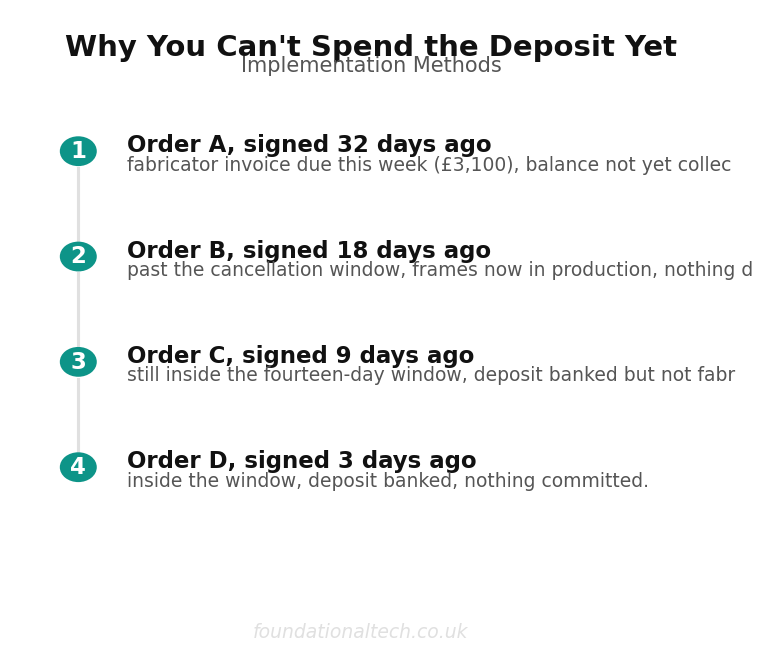
Run more than one job at a time — which is the entire point of the business — and these two clocks stop being a single calculation and become a moving picture. Take a two-fitter firm with four live orders on a Monday morning:
Order A, signed 32 days ago: fabricator invoice due this week (£3,100), balance not yet collected because the install isn't until Thursday.
Order B, signed 18 days ago: past the cancellation window, frames now in production, nothing due yet.
Order C, signed 9 days ago: still inside the fourteen-day window, deposit banked but not fabricator-committed, no order placed.
Order D, signed 3 days ago: inside the window, deposit banked, nothing committed.
The fabricator invoice on Order A is due before the balance on Order A lands, because the invoice clock started on the day the order was placed, not the day the job finishes. If Order A's balance is scheduled to be collected on the Thursday fit date and the fabricator invoice falls due on the Tuesday, that's a two-day gap the business has to fund from somewhere. Usually it comes from the deposits sitting against Orders C and D — a borrowing-from-Peter-to-pay-Paul pattern that feels fine until one order cancels and the sums stop working. A simple weekly forecast — four columns, one per live order, tracking deposit collected, fabricator invoice due date, and balance collection date — catches this before it becomes an overdraft conversation. Most job-management tools won't build that forecast for you automatically; it's worth keeping as a standing spreadsheet or a dashboard view pulled from Xero's aged payables and receivables, checked every Monday without fail.
Collecting the Balance Without Handing a Chunk of It to a Card Machine
Balances in this trade are large by trade standards — commonly £3,000 to £8,000 on a full house re-glaze. That scale means the payment method you default to isn't a minor admin choice, it's a cost line. Take a £4,480 balance, the kind of figure a mid-sized order leaves once the deposit's been deducted. Paid by card through Stripe at 1.5% plus 20p, the fee comes to £67.40, gone before the money's even settled in your account. Route the identical balance through GoCardless Direct Debit and the fee structure works differently. The Standard plan charges 1% plus 20p capped at £4 on the first £2,000 of the payment, then 0.3% with no cap on anything above that. On £4,480, that's the £4 cap plus £7.44 on the remaining £2,480 — £11.44 total. Fifty-six pounds stays in your account instead of a card processor's, on that one collection, and it repeats on every fit-day balance you take for the rest of the year.
The sensible default: set up the GoCardless Direct Debit mandate at the point of order, not the point of collection. That way the balance can be pulled automatically on the day of fit, without a phone call or an awkward moment on the doorstep. Reserve Stripe for the minority of customers who genuinely won't set up a Direct Debit mandate and want to tap a card instead. Xero then reconciles both payment types against the original invoice automatically, provided the bank feed and payment gateway are both connected. Xero's Grow plan, at £30/month, comfortably covers the invoice volume a typical two- or three-fitter glazing firm generates.
A Six-Week Month, Four Orders in Motion
Here's what that Preston-based two-fitter firm's cash position actually looked like across six weeks, tracking real money in and out against the four orders above, plus two more that closed out mid-period:
Week 1: Order D deposit banked (£1,850). Order C's fourteen-day window closes; fabricator order placed same day (£2,650 committed, invoice due in 30 days).
Week 2: Order A's fabricator invoice falls due (£3,100) — funded from the combined deposit pool, not from Order A's own balance, which isn't due until fit day. Order B's frames arrive; fit scheduled.
Week 3: Order B fitted. Balance collected via GoCardless same day (£4,690, fee £12.07). FENSA notification logged.
Week 4: Order A fitted. Balance collected (£3,900, fee £9.70). Order E signed — new fourteen-day clock starts.
Week 5: Order C's fabricator invoice falls due (£2,650) — funded from Order D and Order E deposits, since neither of those jobs is fit-ready yet. This is the tightest week of the six. Two fabricator invoices have now been settled from deposit money alone, before a single one of the three most recent orders — C, D or E — has reached balance collection.
Week 6: Order D fitted. Balance collected (£4,480, fee £11.44). Cash position recovers.
Across the six weeks, total fabricator liability settled: £11,850. Total balances and deposits collected: £22,750. The business was never actually short. But week 5 shows exactly where a firm running deposits too low, or ordering frames before day fifteen out of impatience, turns a manageable timing gap into a genuine cash crunch.
Related guides: If you found this useful, see our guide on FENSA, PAS 24 and the Four-Supplier Invoice: Automating Back-Office Compliance for UK Window and Door Installers (2026) and How to Connect Heatpunk, Payaca, Xero and the DNO Portal: The Complete UK Heat Pump and Solar Integration Map (2026).
How many live orders do you have right now — and could you tell me, without opening the accounts, which ones have a fabricator invoice falling due this month?