Key Takeaway
UK accounting practice grew from 65 to 140 clients without hiring. Full stack cost £210/mo. See the complete automation case study.
In January, the practice carried 65 clients and two people who were quietly drowning. By June, it carried 140 clients and the same two people — now leaving the office at 5pm. Nothing about the team changed. Everything about the plumbing did.
This is a composite case study, built from the real tools, real prices, and real benchmarks covered across this cluster. The numbers are deliberately conservative — they reflect what UK practices actually report in the first six months of building an automated stack, not a vendor's best-case slide. If you run a small practice and recognise the starting point, the path out is more straightforward than you think.
The Starting Point
Call it Marsh & Co, a two-person bookkeeping and accounts practice in the Midlands. Anna runs the books and the clients; her colleague Tom handles data entry, chasing, and payroll. Sixty-five clients, mostly sole traders and small limited companies, turning over roughly £140,000 a year in fees.
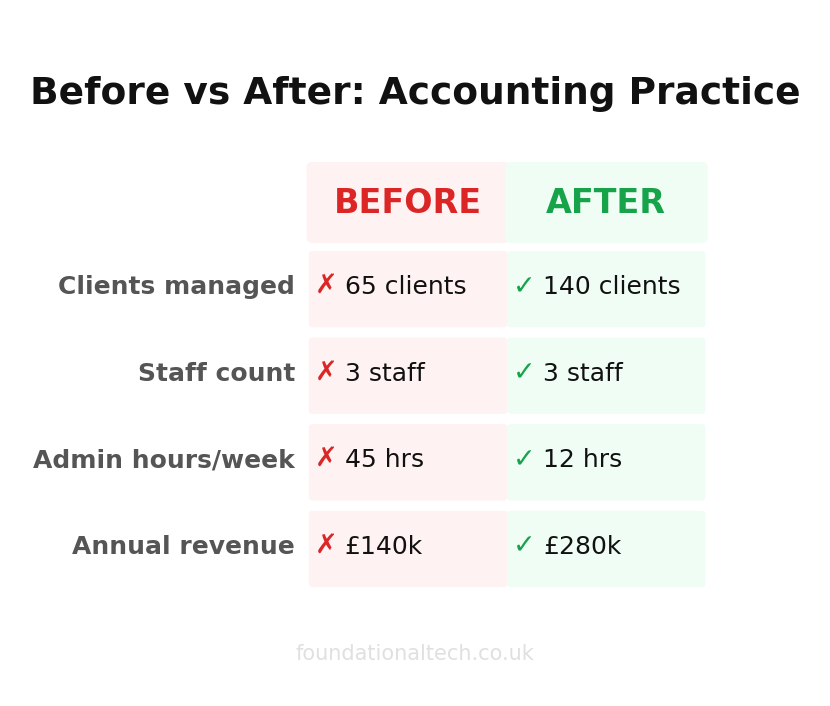
The problem wasn't sales. The problem was that every new client made the practice slower. Onboarding meant a Word engagement letter, a PDF emailed back and forth, a paper ID check, and a fortnight of email tennis before any work began. Receipts arrived as carrier bags, WhatsApp photos, and the occasional shoebox. Tom spent his mornings typing them into Xero by hand. Bank reconciliation ate Thursdays. Invoices went out on the last day of the month and got paid, on average, 45 days later — so the practice was permanently financing its own clients.
Anna had stopped taking new work. Not because she didn't want to grow, but because she physically couldn't. The practice was at capacity at 65 clients. The benchmark that haunts firms like hers: the average UK bookkeeping practice spends around 62% of billable time on compliance and data processing — the exact work software does better.
Then Making Tax Digital for Income Tax arrived. From 6 April 2026, clients earning over £50,000 from self-employment or property moved to quarterly digital filing. Anna's annual rhythm became a quarterly one overnight. Four touchpoints a year per affected client, not one. At 65 clients, the old way wasn't just inefficient — it was about to become impossible.
Month 1: The Foundation
Anna started where the cluster's pillar article says to start: the front door and the data pipe. (See articles 1 to 3 — the automation pillar, the onboarding workflow, and the cash flow piece.)
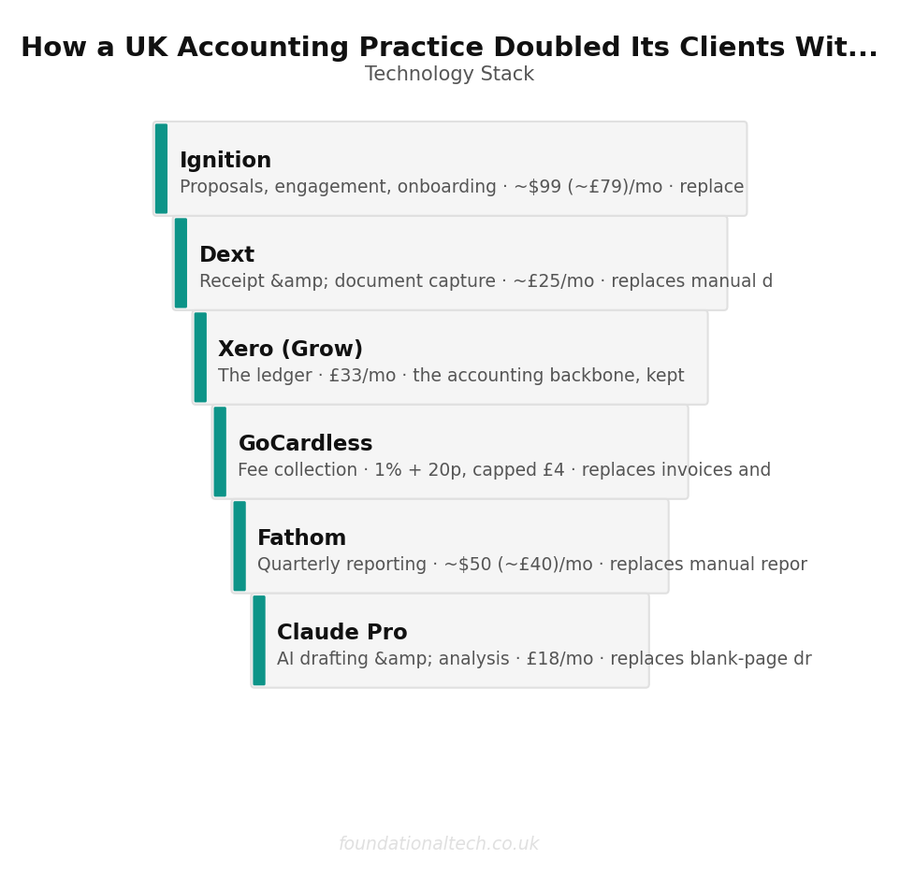
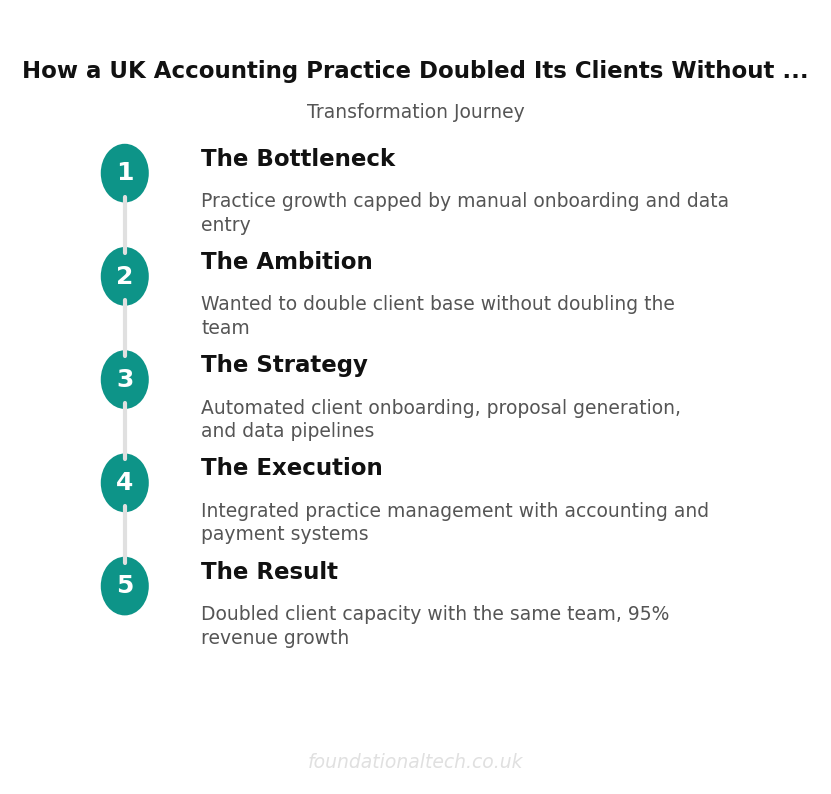
Onboarding moved to Ignition. Out went the Word letter and the PDF chase. A prospect now received a single Ignition proposal: scope, price, engagement terms, and a payment mandate in one link. They clicked accept, signed digitally, and set up direct debit in the same flow. What took a fortnight took an afternoon. Ignition's Core plan runs about $99/month — the practice's single biggest new line, and the one that paid for itself fastest by simply ending the unbilled onboarding drag.
Receipts moved to Dext. Clients were given the app and told: photograph it, forward it, or email it. Dext read each receipt and pushed the data into Xero. Tom's morning typing — three hours, most days — collapsed to a review-and-approve task. Dext business plans start from £24/month.
Collection moved to GoCardless. Every engagement letter now carried a direct debit mandate. Instead of issuing an invoice and waiting, the practice collected fees automatically on the due date. GoCardless charges 1% + 20p per transaction, capped at £4, with no monthly fee. Days-to-payment began falling immediately.
By the end of month one, the practice hadn't added a single client. It had simply stopped leaking time. Tom got his mornings back. Anna got her front door working.
Month 2: The AI Layer
With the automation skeleton in place, Anna added intelligence on top — the AI block from articles 6 to 9.
Claude became the drafting desk. Anna set up a Claude Pro Project configured for the practice: UK tax rates for 2025/26, the firm's house style, the client list in anonymised summary. Management accounts commentary that used to take 45 minutes now took eight — Claude pulled the figures, drafted the variance narrative, and Anna added the context only she knew. Client emails, MTD briefings, and HMRC letters all started as Claude drafts she edited rather than blank pages she dreaded. Claude Pro: £18/month.
The bank feed got an AI watchdog. Following the workflow in article 9, Anna built a Make.com scenario that pulled each week's new transactions from Xero every Monday and asked Claude to flag anomalies — outsized payments, duplicates, anything off-pattern. A short exceptions report landed in her inbox before she opened the ledger. Reconciliation stopped being a hunt and became a review. Make.com Core: about £8/month.
Reporting moved to Fathom. Quarterly MTD updates meant clients now expected to see their numbers four times a year, not once. Fathom turned the Xero data into clean, visual quarterly reports automatically. The financial reporting tier starts around $50/month, and it converted a chore into a billable advisory touchpoint — the moment Anna started selling advice rather than just compliance.
The shift in month two was qualitative. In month one the practice got faster. In month two it got smarter. Anna was no longer producing work; she was reviewing AI-drafted work and adding the judgement clients actually pay for.
Month 3: The Compound Effect
Here is where the separate tools stopped being separate tools and became a system.
A new client now signed an Ignition proposal on a Tuesday. Direct debit activated automatically. Their record appeared in Xero. They downloaded Dext and started forwarding receipts, which coded themselves. Bank feeds reconciled with an AI exceptions report instead of a manual trawl. Fathom generated their quarterly pack. GoCardless collected the fee on time, every time. From signature to fully-onboarded, working client: under a week, with Anna touching maybe an hour of it.
Capacity stopped being the constraint. Anna started saying yes again — and because each new client now cost a fraction of the time, the practice absorbed them without strain. By June, 140 clients. Same two people. Shorter days.
The Numbers
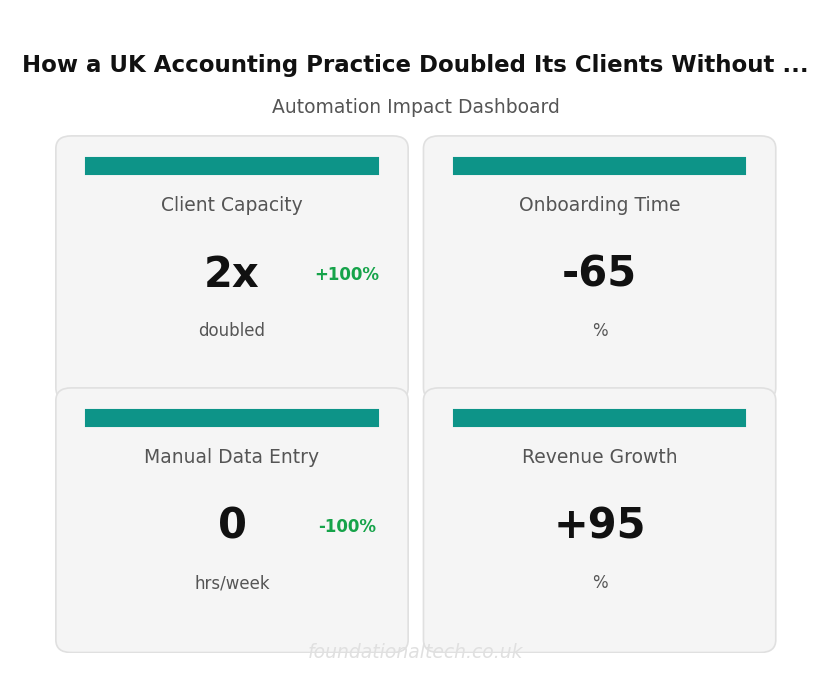
Hours saved per week: roughly 22 across the two of them (Tom's receipt typing, Anna's drafting and reconciliation)
Revenue increase: fees roughly doubled, from ~£140,000 to ~£280,000 annualised, as client count grew from 65 to 140
Days to payment (before → after): 45 days → 3 days (direct debit collected on due date)
Client capacity increase: ~115% more clients with zero new headcount
Annual cost of the full stack: roughly £2,500 (see table below)
ROI: the stack cost under 1% of the additional fee income it enabled
The Full Stack Summary
Ignition — Proposals, engagement, onboarding · ~$99 (~£79)/mo · replaces Word letters, PDF chase, manual setup
Dext — Receipt & document capture · ~£24/mo · replaces manual data entry into Xero
Xero (Growing) — The ledger · £37/mo · the accounting backbone, kept
GoCardless — Fee collection · 1% + 20p, capped £4 · replaces invoices and 45-day waits
Fathom — Quarterly reporting · ~$50 (~£40)/mo · replaces manual report building
Claude Pro — AI drafting & analysis · £18/mo · replaces blank-page drafting
Make.com (Core) — Wiring AI to the stack · ~£8/mo · the new layer
Pricing verified June 2026. USD-priced tools (Ignition, Fathom) shown with approximate GBP conversion at prevailing rates — confirm current figures and exchange before budgeting. Xero UK plans: Standard £33, Growing £37.
The headline figure: a complete automated practice for roughly £210/month, all in. Less than the cost of one afternoon of a part-time junior, replacing the work of considerably more than one.
115% more clients, 0 new hires
from 65 to 140 clients by automating onboarding, bookkeeping and compliance
What They'd Do Differently
Anna is candid about the missteps.
Start with the front door, not the shiny AI. She was tempted to begin with Claude because it was the exciting part. The bigger win came from Ignition and GoCardless — fixing onboarding and cash flow first meant every later improvement compounded on a stable base. Automate intake before you automate intelligence.
Don't configure for a fortnight before using anything. The practices that stall are the ones that try to build the perfect system before processing a single receipt. Anna turned on Dext with default settings, used it for a week, then refined. Incremental beats perfect.
Keep the human gate, always. Every AI workflow she built writes a suggestion — a draft email, a flagged transaction, a proposed code. Nothing posts to the ledger or sends to a client without her reading it. That single rule is what let her trust the system at speed without lying awake about her indemnity cover.
Tell clients what's changing. A few balked at direct debit until Anna framed it plainly: it meant she spent her time on their accounts, not on chasing their payments. Reframed as a benefit, adoption was near-universal.
The quarterly cadence is the real test. MTD for Income Tax turned filing from annual to quarterly. Without the stack, that would have quadrupled the admin. With it, the extra touchpoints became near-automatic — and a reason for clients to pay for more frequent advice rather than less.
The lesson underneath all of it: the practice didn't grow by working harder or hiring. It grew by removing the manual steps between a client signing and a client being served. Each tool saved a little. Wired together, they changed what the business could be.
Could your practice double its clients without doubling its hours? Reply with your single biggest bottleneck — onboarding, receipts, reconciliation, or getting paid — and I'll tell you exactly which part of this stack to build first.
This is exactly what A & Y Financial Services does. We take accounting and bookkeeping practices from manual chaos to automated clarity — and we start by fixing the step that's costing you the most. Let's talk.